Poland 7-Day Itinerary: Warsaw, Kraków and Gdańsk
Contents
- Budget Tiers
- Days 1–2: Warsaw
- Day 1: Old Town and History
- Day 2: POLIN, Praga, and the Palace of Culture
- Days 3–4: Kraków
- Day 3: Wawel, the Main Square, and Kazimierz
- Day 4: Schindler’s Factory and Rynek Główny
- Day 5: Day Trip from Kraków — Wieliczka Salt Mine or Auschwitz
- Days 6–7: Gdańsk
- Day 6: The Old Town and Solidarity Museum
- Day 7: Sopot and Departure
- Transport Summary
- Tips for This Itinerary
Seven days is the right length for a first trip to Poland that takes the three great cities seriously without rushing. Warsaw, Kraków, and Gdańsk each have distinct identities — Warsaw rebuilt and forward-facing, Kraków medieval and compact, Gdańsk maritime and haunted by the Second World War in a different register from the rest of the country.
This itinerary runs south to north, starting in Warsaw and ending in Gdańsk, which works well with most international flight connections.
Budget Tiers
| Tier | Daily Budget | Accommodation | Meals | Notes |
|---|---|---|---|---|
| Budget | ~PLN 150/day | Hostel PLN 60–80/night | PLN 40–60 on street food, milk bars | Transport PLN 20–30 |
| Mid-range | ~PLN 350/day | Hotel from PLN 220–280/night | PLN 80–120 in sit-down restaurants | |
| Splurge | ~PLN 800+/day | Hotel from PLN 550–700/night | PLN 150–200+ in fine dining |
All prices are approximate as of 2026.
Days 1–2: Warsaw
Warsaw is a city that has reinvented itself multiple times. Almost entirely destroyed after the 1944 Uprising, it was rebuilt from old paintings and photographs, creating a reconstructed Old Town that is paradoxically both accurate and brand new. The modern city that grew around it is confident, loud, and worth more than a single day.
Day 1: Old Town and History
Start at the Zamek Królewski (Royal Castle): entry approximately PLN 35 per adult as of 2026; open Tue–Sun from 10am. This is Poland’s most important royal residence, rebuilt from rubble after the war and housing an impressive collection of Polish royal portraits, apartments, and Canaletto paintings of Warsaw as it looked before 1939.
Walk north along the Castle Square and into the Old Town (Stare Miasto). The coloured townhouses, cobbled lanes, and the city walls are all reconstructions, but that context makes them more interesting, not less. Coffee at one of the cafés on the Old Town Market Square.
Afternoon: walk south to the Warsaw Rising Museum (ul. Grzybowska 79; approximately PLN 35 adults; closed Tuesday; allow 2–3 hours). This is one of the finest museums of 20th-century history in Europe.
Evening: dinner in the Powiśle neighbourhood, a riverside area with good mid-range restaurants. Kulturalna (Pl. Defilad 1, inside the Palace of Culture) serves solid Polish food at mid-range prices (approximately PLN 60–90 per person as of 2026). For a budget option, Bar Mleczny Bambino (ul. Wspólna 48) is an authentic milk bar serving traditional Polish food for approximately PLN 15–25 per person as of 2026.
Day 2: POLIN, Praga, and the Palace of Culture
Morning: POLIN Museum of the History of Polish Jews (ul. Andersa 6; approximately PLN 30 adults; free on Thu; 10am–6pm, closed Tue and certain Jewish holidays). This is a major exhibition — allow at least 3 hours for the permanent collection documenting 1,000 years of Jewish life in Poland.
Afternoon: cross the Vistula to the Praga district — Warsaw’s east bank, less polished than the Old Town side, more honest, better for street art and independent cafés. Walk the Brzeska–Ząbkowska corridor for the best of the neighbourhood.
Evening: back in central Warsaw, the Palace of Culture and Science observation deck (Sky Bar on floor 30; approximately PLN 25 entry as of 2026) gives the best panorama of the city skyline at dusk.
Where to sleep:
- Budget: Oki Doki Old Town Hostel (Pl. Dąbrowskiego 3; dorm from approximately PLN 70 as of 2026)
- Mid-range: Hotel Bristol (Krakowskie Przedmieście 42/44; from approximately PLN 500/night as of 2026 — historic, landmark property on Warsaw’s Royal Route)
- Mid-range (value): Puro Hotel Warsaw (ul. Ogrodowa 9; from approximately PLN 280/night as of 2026)
Days 3–4: Kraków
Kraków takes approximately 2.5 hours from Warsaw by PKP InterCity express train (approximately PLN 70–120 as of 2026; book in advance at pkp.pl).
Day 3: Wawel, the Main Square, and Kazimierz
Morning: walk up to Wawel Castle — arrive by 9am to beat the crowds. The State Rooms (PLN 35) and Cathedral (PLN 15) are the priority; allow 3 hours for the hill complex.
Lunch in the Old Town. Milkbar Tomasza (ul. Tomasza 24) serves very good traditional Polish food at budget prices (approximately PLN 20–35 per person as of 2026). For mid-range, Miód Malina (ul. Grodzka 40) is consistently good for Polish classics at approximately PLN 60–80 per person as of 2026.
Afternoon: walk south to Kazimierz — the Jewish quarter. Wander the streets between ul. Szeroka and ul. Józefa, look into the Old Synagogue (PLN 15), and walk as far as the Galicia Jewish Museum (PLN 25) on ul. Dajwór.
Evening: dinner in Kazimierz. Hamsa (ul. Szeroka 2) is a good choice for Israeli-influenced food in the Jewish quarter setting (approximately PLN 60–90 per person as of 2026). Alternatively, Café Szafé (ul. Józefa 9) for a quieter café dinner.
Day 4: Schindler’s Factory and Rynek Główny
Morning: cross the Vistula footbridge into Podgórze and walk to Schindler’s Factory (Fabryka Schindlera, ul. Lipowa 4; PLN 26; free Thursday; open 10am, closed Tue; pre-book at muzeumkrakowa.pl). Allow 2–3 hours.
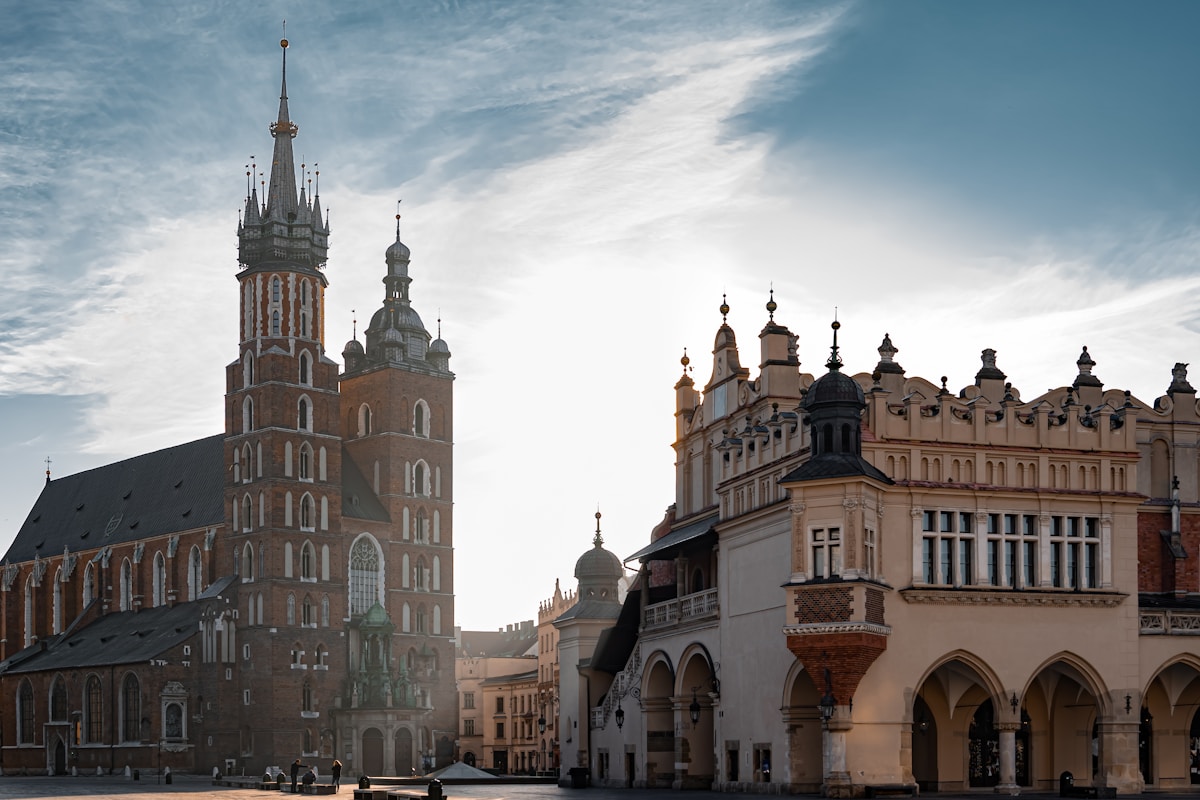
Afternoon: back in the Old Town, spend time on the Rynek Główny (Main Market Square). Visit St Mary’s Basilica (PLN 15; open for tourists outside Mass times — check notice on door) for the Wit Stwosz altarpiece. The Cloth Hall has a free ground floor with stalls selling amber, folk art, and traditional crafts.
Evening: head to the Podgórze district’s trendy restaurant strip or back to Kazimierz. Marchewka z Groszkiem (ul. Mostowa 2) does excellent modern Polish food (mid-range, approximately PLN 70–100 per person as of 2026).
Where to sleep:
- Budget: Greg & Tom Beer House Hostel (ul. Pawia 12/7; dorm from approximately PLN 65 as of 2026)
- Mid-range: Hotel Pugetów (ul. Starowiślna 15a; from approximately PLN 280/night as of 2026)
- Splurge: Hotel Copernicus (ul. Kanonicza 16; from approximately PLN 700/night as of 2026 — Gothic townhouse steps from Wawel)
Day 5: Day Trip from Kraków — Wieliczka Salt Mine or Auschwitz
Choose one — not both.
Wieliczka Salt Mine (recommended for those on a shorter itinerary or if you prefer to avoid heavy historical content): Bus 304 from Kraków Główny bus station, approximately 30 minutes, approximately PLN 4 each way. Online tickets approximately PLN 89 adults. Half-day excursion, back in Kraków by early afternoon with time for more of the Old Town.
Auschwitz-Birkenau (recommended for anyone with a serious interest in WWII history): PKS bus from Kraków Główny, approximately 1.5 hours each way, approximately PLN 15–18. Pre-book a guided tour at auschwitz.org — this is mandatory and sells out in advance. Plan a full day; this is not an excursion to rush.
Days 6–7: Gdańsk
Train from Kraków to Gdańsk: approximately 5.5–6 hours direct, or approximately 4.5 hours with one change in Warsaw. Cost approximately PLN 100–180 as of 2026. Book in advance at pkp.pl.
Day 6: The Old Town and Solidarity Museum
Walk from Gdańsk Główny station to the Długi Targ (Long Market) and the Fontanna Neptuna (Neptune’s Fountain) — the iconic heart of Gdańsk’s medieval waterfront. The coloured facades along Długi Targ and Długa Street are originals restored after WWII. Walk north to the Crane Gate (Brama Żuraw) on the Motława River — a 15th-century crane gate that loaded cargo onto ships; now housing a branch of the National Maritime Museum (approximately PLN 20 as of 2026).
Afternoon: the European Solidarity Centre (Europejskie Centrum Solidarności; pl. Solidarności 1; approximately PLN 20 adults; 10am–7pm in summer): this museum documents the Solidarity movement (Solidarność) that launched at the Lenin Shipyard in Gdańsk in 1980 and became the crack in communist Eastern Europe that led, nine years later, to the fall of the Berlin Wall. One of the finest political history museums in Europe; allow 2–3 hours.
Dinner: Restauracja Metamorfoza (ul. Mariacka 33; mid-range, approximately PLN 70–100 per person as of 2026) on the famous amber-shop street. For something more casual, Bar Mleczny Neptun (ul. Długa 33/34; budget, approximately PLN 20–30 as of 2026).
Day 7: Sopot and Departure
The resort town of Sopot, 12km north of Gdańsk, is reached by SKM commuter train from Gdańsk Główny in approximately 20 minutes (approximately PLN 5 as of 2026). Sopot’s long wooden pier (molo) is the longest in the Baltic (511 metres; entry approximately PLN 10 as of 2026) and the town has a good beach and a famous crooked house (Krzywy Domek) worth a photograph.
Return to Gdańsk for your train or flight departure. Gdańsk Lech Wałęsa Airport is 10km from the city centre; taxi approximately PLN 50 as of 2026, or bus.
Where to sleep in Gdańsk:
- Budget: 3City Hostel (ul. Tokarska 15; dorm from approximately PLN 65 as of 2026)
- Mid-range: Hotel Podewils (ul. Szafarnia 2; from approximately PLN 320/night as of 2026 — riverside location, 17th-century building)
- Splurge: Hilton Gdańsk (ul. Targ Rybny 1; from approximately PLN 650/night as of 2026 — direct views of Crane Gate and the Motława)
Transport Summary
| Route | Transport | Duration | Cost (approx. 2026) |
|---|---|---|---|
| Warsaw → Kraków | PKP express | ~2.5 hrs | PLN 70–120 |
| Kraków → Wieliczka | Bus 304 | ~30 min | PLN 4 each way |
| Kraków → Auschwitz | PKS bus | ~1.5 hrs | PLN 15–18 each way |
| Kraków → Gdańsk | PKP direct | ~5.5–6 hrs | PLN 100–180 |
| Gdańsk → Sopot | SKM train | ~20 min | PLN 5 each way |
Book long-distance trains at pkp.pl or the PKP Intercity app. Prices increase closer to travel dates.
Tips for This Itinerary
- Purchase an ISIC or Euro26 card if eligible — Polish museums frequently offer substantial student/youth reductions.
- Central Kraków and central Gdańsk are both compact and walkable; you will not need much local transport.
- The zloty (PLN) is the Polish currency. Card payments are widely accepted everywhere except some milk bars and market stalls; carry small amounts of cash.
- Check pkp.pl for train times. Polish rail is reliable and punctual on express services; regional trains vary.
Book an experience
Itinerary in the area
Instant confirmation · Free cancellation on most bookings
Frequently Asked Questions
- Is 7 days enough to see Warsaw, Kraków and Gdańsk?
- Seven days is enough for a solid introduction to all three cities, including a day trip from Kraków to Wieliczka Salt Mine or Auschwitz. You will not exhaust any of them — each city rewards longer stays — but you will cover the essential history, architecture, and food.
- How do you travel between Warsaw, Kraków and Gdańsk?
- PKP InterCity trains are the standard option. Warsaw to Kraków takes approximately 2.5 hours by express; cost approximately PLN 70–120 as of 2026. Kraków to Gdańsk takes approximately 5.5–6 hours direct or around 4.5 hours with one change; cost approximately PLN 100–180 as of 2026.
- What is the best day trip from Kraków?
- Both Wieliczka Salt Mine (30 minutes, half-day) and Auschwitz-Birkenau (1.5 hours, full day) are outstanding. Choose Wieliczka if you have limited time; choose Auschwitz if you want to engage with the WWII history that defines so much of Kraków. Do not try to combine them.
- What is the best base for exploring Gdańsk?
- Stay in central Gdańsk within walking distance of Długi Targ (Long Market) and the Old Town waterfront. The Sopot and Gdynia day trip can be done by fast commuter rail (SKM) in under 30 minutes.
- Is Poland expensive to travel?
- Poland is one of the more affordable countries in central Europe. Budget travellers can manage comfortably on approximately PLN 150–200 per day. Mid-range travel with a private hotel room, sit-down meals, and paid attractions runs approximately PLN 350–450 per day as of 2026.