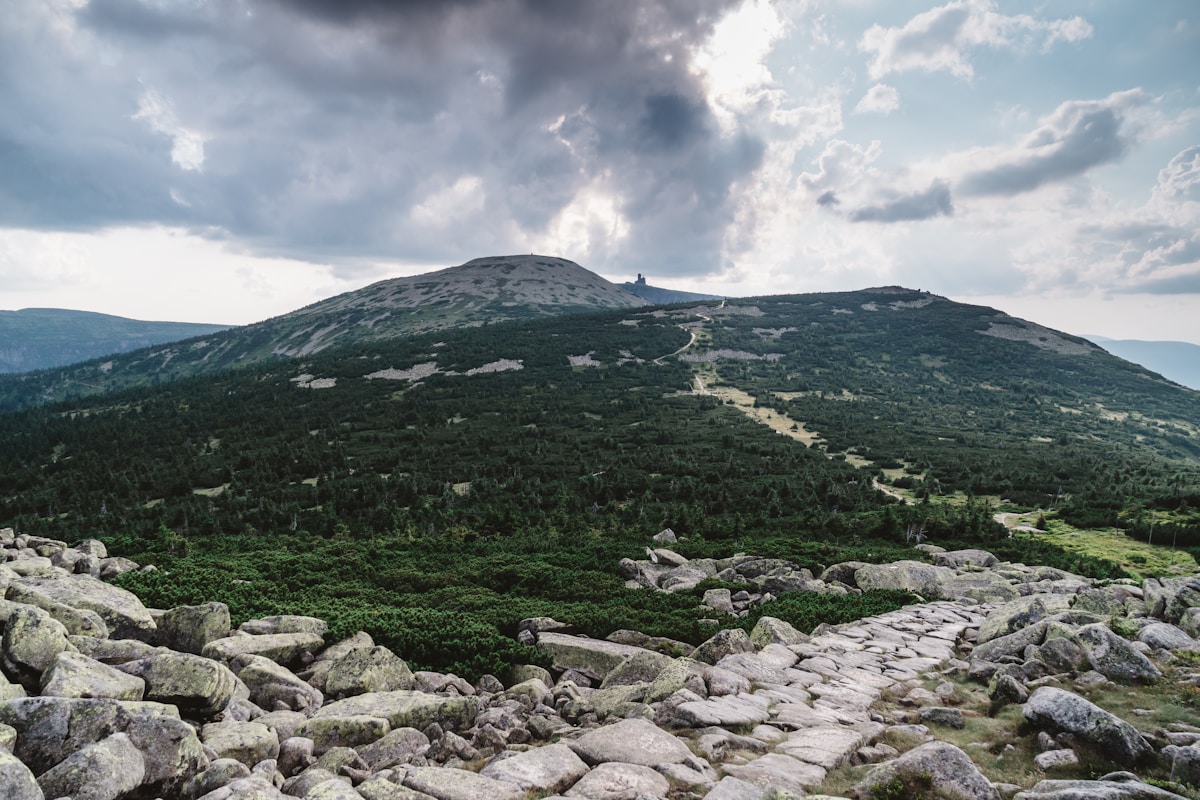
Jelenia Góra sits at the foot of the Karkonosze range, the highest ridge of the Sudeten Mountains, and it gives access to trails, ski areas, and viewpoints that most visitors in Lower Silesia miss. The city itself also has more than the mountains: a well-preserved Baroque Old Town with arcaded market square, a spa quarter with genuine hot springs, and easy connections into Karkonosze National Park.
Karkonosze National Park
The park begins on the edge of the city and the easiest entry point is via Karpacz or Szklarska Poręba - two mountain resort towns roughly 15–30 km from Jelenia Góra by bus. The ridge trail runs the length of the Czech border; from the Polish side the key summits are Śnieżka (1,602 m), the highest peak in the Sudeten range, and Szrenica (1,362 m) above Szklarska Poręba.
The hike from Karpacz Górny to Śnieżka takes around 3–4 hours return via the red-marked trail through the Śnieżne Kotły glacial cirques. The cable car from Karpacz Górny to Kopa station cuts the ascent by about 90 minutes; from Kopa, a 1.5-hour walk along the ridge leads to the summit observatory, which has a café and panoramic views into both Poland and the Czech Republic. Tickets for the cable car cost approximately 45 PLN / €10 return as of 2026.
The Śnieżne Kotły (Snow Pots) - a pair of glacial cirques below the ridge - can be reached on a well-marked trail from Szklarska Poręba and are among the most dramatic natural features in the Polish mountains outside Tatry.
Old Town Square
Jelenia Góra’s Rynek is one of the most intact Baroque market squares in Lower Silesia. The square is bordered on all four sides by arcaded townhouses, a form more typical of Italian piazzas than Polish towns, which gives it a distinctive character. The pastel-coloured facades and continuous arcade at street level make it photogenic in all weathers.
The St. Erasmus and Roch Church at the corner of the square has a fine Baroque interior with elaborate stucco work. The old Town Hall tower is climbable in summer and gives a good view over the rooflines. Allow around 2 hours to explore the Old Town thoroughly; café options under the arcades include reliable coffee and Polish pastries.
Cieplice Śląskie-Zdrój
Cieplice is a spa district incorporated into Jelenia Góra that has functioned as a health resort since the 16th century. Its hot springs - Poland’s oldest thermal baths - emerge at around 44°C. The main draw is the Termy Cieplickie bathing complex with indoor and outdoor thermal pools, open year-round. Entry costs approximately 50–80 PLN / €12–18 for a day pass as of 2026, depending on the season and duration.
The Schaffgotsch Palace in Cieplice, a large Baroque residence, is now partly occupied by a hotel and restaurant. The palace park behind it is free to walk and pleasant in spring and autumn. The district also has a small natural history museum with a collection of Sudeten minerals.
Karpacz and the Wang Church
Karpacz, a 15 km bus ride south of Jelenia Góra, is the main access point for Śnieżka and houses one of Poland’s most unusual heritage buildings: the Wang Church (Kościół Wang), a wooden stave church built in Norway around 1150 and transported to the mountains in 1842 by the Prussian King Friedrich Wilhelm IV. It sits in a clearing above the town with views to the ridge. Entry costs approximately 20 PLN / €5 as of 2026. The church is tiny - interior visits take 20 minutes - but the surrounding mountain scenery and the strangeness of a Norwegian medieval church in Lower Silesia make it worth the trip.
Szklarska Poręba and the Falls
Szklarska Poręba, 30 km west, is the other main resort town and the access point for Szrenica and the western Karkonosze trails. The Kamieńczyk Waterfall - the highest in the Polish Sudeten at 27 m - is a 90-minute round trip from the town centre. Entry to the waterfall trail costs approximately 10 PLN / €2.50 as of 2026. The town has more upscale hotel options than Karpacz and is the base for the Szrenica ski area in winter.
Search hotels in Jelenia Góra on Booking.com
Practical Details
Jelenia Góra is most easily explored by bus and train within the Lower Silesia network. The bus station and train station are next to each other, with frequent connections to Karpacz and Szklarska Poręba. Most Karkonosze trails are well-marked and manageable for anyone in reasonable fitness; higher ridge routes require good footwear and should not be attempted in poor visibility without experience. Mountain rescue (GOPR Karkonosze) operates year-round and can be reached on emergency number 985.
The best months for hiking are June to September; January to March for skiing. April, May, and October are shoulder months - fewer crowds and lower prices, with the risk of variable weather on the ridge. Guided tours into Karkonosze departing from Wrocław or Jelenia Góra are a good option for a first visit to the mountains, with local guides who know the trail conditions and weather patterns well.
More in Jelenia Góra
- Jelenia Góra City Guide - overview, restaurants, and getting there
- Where to Stay in Jelenia Góra - hotels and guesthouses for hikers
- Food to Try in Jelenia Góra - local Silesian cuisine and mountain dishes
- Karkonosze Hiking - the Karkonosze trails and Śnieżka summit guide
- Zakopane vs Jelenia Góra - comparing Poland’s two main mountain regions
- Wrocław City Guide - the nearest major city, 2 hours by train, and a natural starting point
- Day Trips from Wrocław - how Jelenia Góra features in a Wrocław-based itinerary
- Tatra Mountains Trekking - Poland’s other great hiking area for comparison
- Best Time to Visit Poland - June to September is the Karkonosze hiking window