Wrocław is one of Poland’s most enjoyable cities for a short stay - compact enough to cover on foot, full of architectural surprises, and with a food and café scene that punches well above its size. A weekend gives you time to explore the historic core without rushing, find a handful of bronze dwarfs, and cross the bridges to the island cathedral district that feels removed from the rest of the city.
Day 1: Market Square, Dwarfs and Panorama Racławicka
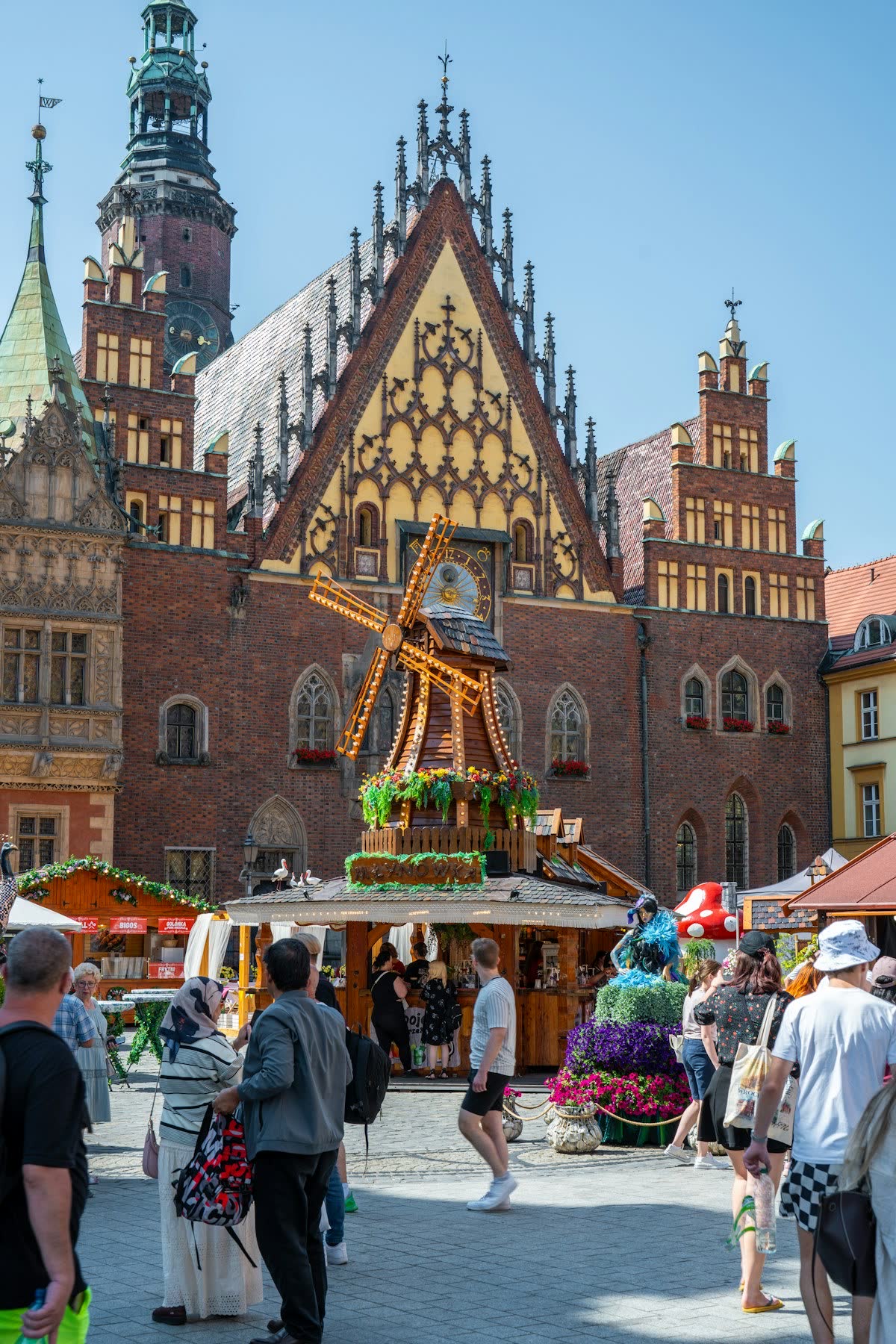
Start at Rynek - Wrocław’s Market Square - one of the largest medieval market squares in Central Europe, second in Poland only to Kraków’s. The square is dominated by the Town Hall (Ratusz), a 14th-century Gothic building covered in ornate facades that took two centuries to complete. Entry to the interior museum costs approximately PLN 20 as of 2026; the exterior is free and worth a long look. The clock mechanism on the tower’s eastern face is a popular photo stop.
Walking the streets radiating off the Rynek, keep your eyes low - the Wrocław Dwarfs (krasnale) hide on corners, in doorways, against building bases, and beside lampposts throughout the city. The first dwarf was placed in 2001 as a symbolic reference to the 1980s Orange Alternative protest movement; the collection has grown to over 600 figures across the city. Around 30–40 are clustered near and around the Rynek within easy walking distance. The tourist office on the square sells a printed map; the free WroclawDwarfs app also marks every figure.
Panorama Racławicka is a 15-minute walk south of the Rynek (or a short tram ride). The panoramic painting depicts the 1794 Battle of Racławice - a Polish victory over Russian forces - on a cylindrical canvas 114 metres wide and 15 metres tall. Viewed from a central platform in a darkened cylindrical room with landscaped foreground, it creates a convincing 360° illusion of being in the battle. Entry approximately PLN 35 for adults, PLN 25 for students as of 2026. Timed entry sessions run throughout the day; book ahead at weekends.
Lunch: Pod Papugami (ul. Świdnicka 37) is a long-running milk bar with traditional Polish standards - bigos, żurek, kotlet schabowy (breaded pork cutlet). Lunch from approximately PLN 20–35 as of 2026. For something more contemporary, Kurna Chata (ul. Świdnicka 52) serves Polish regional dishes in a slightly smarter setting; mains approximately PLN 40–65 as of 2026.
Afternoon: Explore the streets around the University Quarter. The University of Wrocław (Uniwersytet Wrocławski) fronts the Odra River on ul. Universitecka. The Baroque Aula Leopoldina inside the university building is one of the finest 18th-century ceremonial halls in Central Europe; entry approximately PLN 15 as of 2026 during non-event hours.
Cross to the Piasek Island for a short detour through a small bridge-linked island with the Church of Our Lady on the Sand (Kościół NMP na Piasku) - a 14th-century Gothic hall church that survived WWII relatively intact.
Evening: Return to the Rynek area. For dinner, Restauracja Jadka (ul. Rzeźnicza 24/25) is one of the best traditional Polish kitchens in Wrocław - mains approximately PLN 50–85 as of 2026, with an emphasis on Lower Silesian regional ingredients. For a livelier atmosphere, the streets around ul. Świdnicka have wine bars and modern restaurants opening through to midnight.
Hotels:
- Budget: Hostel Mleczarnia (ul. Włodkowica 5) - in a historic tenement near Kazimierz Wielki Square, dormitory from approximately PLN 60/night, private rooms from approximately PLN 200 as of 2026
- Mid-range: Hotel Patio (ul. Kiełbaśnicza 24) - central location between the Rynek and the Old Town, doubles from approximately PLN 320–480 as of 2026
- Splurge: Hotel Monopol (ul. Świdnicka 51) - a restored 1892 hotel with an Art Nouveau lobby that once hosted Marlene Dietrich; doubles from approximately PLN 550–900 as of 2026
Search hotels in Wrocław on Booking.com
Day 2: Centennial Hall, Zoo and Ostrów Tumski
Centennial Hall (Hala Stulecia) is approximately 3 km east of the Old Town, reachable by tram (lines 4, 9, 17). Built in 1913 and now a UNESCO World Heritage Site, the reinforced concrete hall with its 65-metre dome was an engineering landmark for its era. The adjacent Multimedia Fountain in the surrounding park is the largest in Poland, with programmed water-and-light shows in the evenings (free, check the schedule at halastulecia.pl). Entry to the hall itself costs approximately PLN 18 for adults as of 2026.
Wrocław Zoo (Ogród Zoologiczny) is directly next to Centennial Hall and the most visited zoo in Poland. Entry approximately PLN 50 for adults, PLN 35 for children as of 2026. The zoo is large (around 33 hectares) and houses over 10,000 animals; it is particularly strong on large mammals and reptiles. Allow 2–3 hours minimum. The African House opened in 2014 is especially good. The Afrykarium (Oceanarium and Vivarium inside the zoo) is a separate ticketed area; combined zoo + Afrykarium tickets cost approximately PLN 75 adults as of 2026.
Lunch: The café inside the zoo park is functional but unremarkable. Better to eat before entering or pack snacks. Near Centennial Hall, Restauracja Karczma Spiżarnia (ul. Wystawowa 1) serves traditional Polish food at mid-range prices (approximately PLN 40–70 per main as of 2026).
Ostrów Tumski (Cathedral Island) is the oldest part of Wrocław and the site of the city’s founding in the 10th century. Reached on foot across two short bridges from the city centre (approximately 20 minutes from the Old Town), the island’s cluster of Gothic and Baroque churches feels quieter and more contemplative than the rest of the city.
Wrocław Cathedral (Katedra Świętego Jana Chrzciciela) dominates the island. The Gothic cathedral was largely rebuilt after 1945 (it was 70% destroyed in WWII) and the twin towers now hold the skyline. Entry to the cathedral is free; the tower elevator costs approximately PLN 15 as of 2026 and the view across the island and river is one of the best in the city. The adjacent Archdiocesan Museum has a collection of medieval Silesian art; entry approximately PLN 15 as of 2026.
The gas lamps on Ostrów Tumski are lit by hand each evening - one of the few places in Europe where a lamplighter still makes the daily rounds. The ritual happens around dusk (time varies by season) and is worth watching if you are there in the late afternoon.
Evening: Walk back across the bridges into the Old Town for a final dinner. Restauracja Spiż (ul. Rynek Ratusz 2) in the cellar beneath the Town Hall serves Wrocław’s own brewery beer alongside Polish mains - mains approximately PLN 45–80 as of 2026. The vaulted cellars are atmospheric and the beer is good.
Budget Guide
| Tier | Accommodation/night | Meals/day | Total/day (excl. transport) |
|---|---|---|---|
| Budget | PLN 60–200 | PLN 50–80 | PLN 110–280 |
| Mid-range | PLN 320–480 | PLN 130–200 | PLN 450–680 |
| Splurge | PLN 550–900 | PLN 250–400 | PLN 800–1,300 |
Tram tickets within the city cost approximately PLN 3.40 per single journey as of 2026. A 24-hour ticket costs approximately PLN 15 as of 2026 and covers unlimited tram and bus travel. Attraction entry across the full weekend totals approximately PLN 120–180 per person.
Book Your Trip
- Flights - Find the best fares to Poland · flights guide
- Travel Insurance - Get covered before you go · insurance guide
- eSIM - Stay connected from landing · eSIM guide
- Airport Transfers - Pre-book your transfer from Warsaw or Krakow
- Trains & Buses - Compare fares with Omio
- Car Rental - Compare prices across providers · car hire guide
- Tours & Activities - Browse Poland tours on GetYourGuide