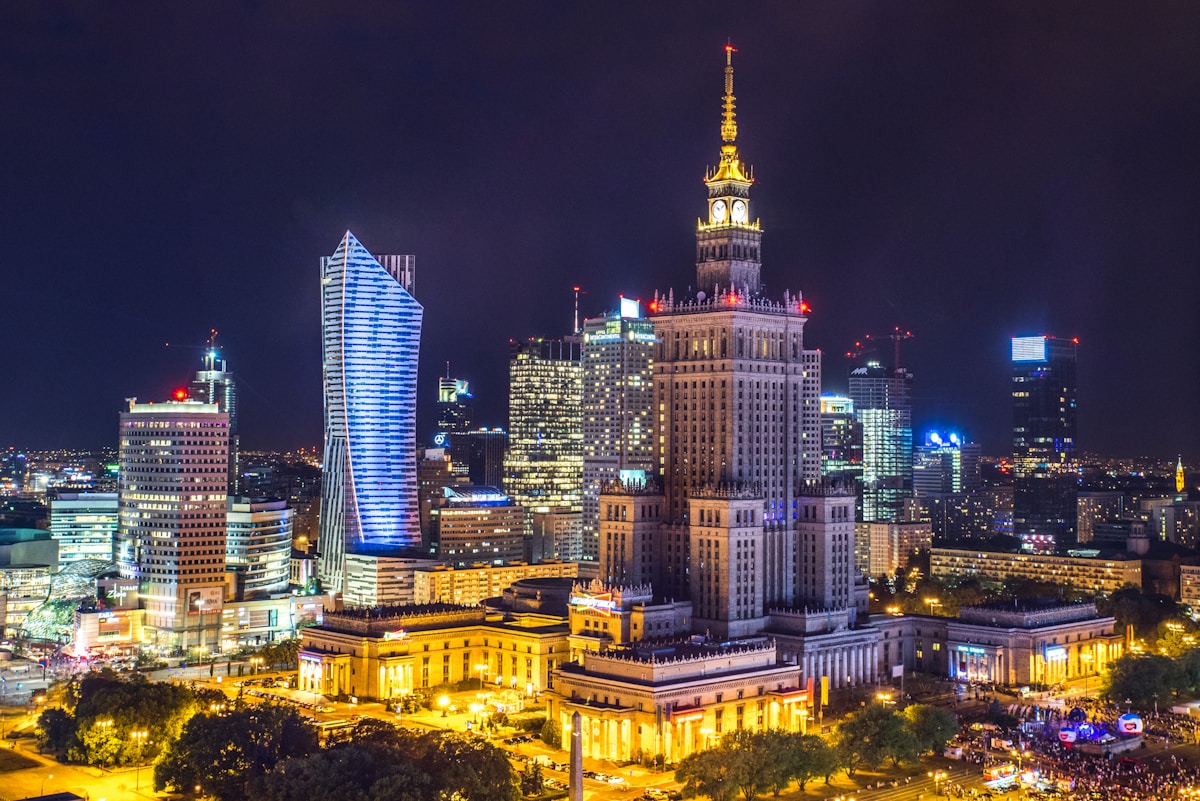
Poland is Central Europe’s largest country and one of its most underestimated. A thousand years of history are compressed into landscapes that shift from Baltic beaches in the north to alpine peaks in the south. This guide covers the essentials: top destinations, how to get around, what things cost, and when to go.
Key Facts About Poland
- Capital: Warsaw (Warszawa)
- Population: approximately 38 million
- Language: Polish (Polski); English is widely spoken in cities, less so in rural areas
- Currency: Polish Zloty (PLN). Exchange rate approximately PLN 4.0–4.5 per euro as of 2026; check current rates before travelling
- Time zone: CET (UTC+1), CEST (UTC+2) in summer
- Electricity: 230V, Type C/E sockets (two-round-pin European standard)
- EU membership: Yes (since 2004); no visa required for EU/EEA citizens or British citizens (90 days). US, Canadian and Australian passport holders do not require a visa for stays under 90 days.
- ETIAS: As of late 2026, non-EU travellers from visa-exempt countries require ETIAS authorisation before entering Poland. Apply at etias.com; fee approximately €7.
Poland’s Top Destinations
Kraków
The royal capital until 1596 and Poland’s cultural heart. Kraków survived World War II largely intact and is the country’s most visited city. Key sights:
- Main Market Square (Rynek Główny): Europe’s largest medieval market square; free to visit
- Wawel Castle and Cathedral: the royal residence; entry to specific exhibitions PLN 30–40 each
- Kazimierz (Jewish quarter): 9 synagogues, restaurants, bars and an atmospheric market
- Wieliczka Salt Mine (15 km from city): UNESCO site; entry approximately PLN 109 as of 2026
- Auschwitz-Birkenau (60 km): free self-guided entry; guided tours approximately PLN 85–100
Getting there from Warsaw: approximately 2.5 hours by PKP Intercity train; tickets from approximately PLN 30–80.
Warsaw
Poland’s capital was 85% destroyed in World War II and rebuilt almost entirely from scratch. The contrast between the carefully reconstructed Old Town and the brutalist communist-era housing estates makes Warsaw unlike any other European city.
Key sights:
- Royal Castle (pl. Zamkowy 4): entry approximately PLN 40; closed Mondays
- Warsaw Rising Museum: entry approximately PLN 30; free Sundays
- POLIN Museum of the History of Polish Jews: entry approximately PLN 35; free Thursdays
- Łazienki Park: free; 76-hectare royal park with palace on the island and outdoor Chopin recitals on Sundays in summer
- Palace of Culture and Science (PKiN): viewing terrace approximately PLN 25; the most visible building in the Warsaw skyline
Getting there from Kraków: approximately 2.5 hours by train.
Gdańsk
Poland’s principal Baltic port and the birthplace of the Solidarity movement. The rebuilt Hanseatic townhouses along Long Lane (ul. Długa) and the Motława waterfront are some of the most striking architecture in Poland.
Key sights:
- Long Lane and Long Market: the pedestrianised historic core; free
- Malbork Castle (60 km south-east, 40 min by train): PLN 60–80 entry
- European Solidarity Centre: PLN 30 entry; highly recommended
- Gdańsk Amber Museum: approximately PLN 25
Getting there from Warsaw: 3 hours by PKP Intercity; tickets from approximately PLN 40–100.
Wrocław
Lower Silesia’s vibrant university city, on the Odra River. A Polish-German-Jewish layered history gives Wrocław a distinctive character. The market square (Rynek) is one of the most beautiful in Poland; the cathedral island (Ostrów Tumski) is the historic heart.
Getting there from Warsaw: approximately 4 hours by train; from Kraków approximately 3 hours.
Zakopane and the Tatra Mountains
Poland’s mountain capital, 100 km south of Kraków. The base for Tatra National Park hiking, skiing and the distinctive Podhalean culture. Direct buses from Kraków approximately every 30 minutes, approximately 2 hours, approximately PLN 20.
Wrocław’s Day Trips
From Wrocław: Malbork Castle; Książ Castle (80 km); Karkonosze National Park and Śnieżka peak (90 km). All accessible by train or car.
Getting Around Poland
Trains
Polish State Railways (PKP) operates an extensive network. PKP Intercity runs express trains on the major city routes:
- Warsaw–Kraków: approximately 2.5 hours; EIP (express) tickets from approximately PLN 30–80 booked in advance
- Warsaw–Gdańsk: approximately 3 hours; from approximately PLN 40–100
- Warsaw–Wrocław: approximately 3.5–4 hours; from approximately PLN 50–120
- Kraków–Wrocław: approximately 3 hours; from approximately PLN 40–90
Book at intercity.pl or via the PKP Bilkom app. Prices rise sharply for same-day purchases; book at least 3–7 days ahead for cheaper fares.
Buses
FlixBus and Polish operator Neobus connect cities not well served by rail. Generally slower than trains but cheaper for off-peak routes. Intercity buses are comfortable.
Driving
Renting a car is the most practical option for the Bieszczady Mountains, Masurian Lakes and off-the-beaten-track areas. Major rental companies (Europcar, Avis, Hertz, Sixt) are represented at all airports and in city centres. A small car costs approximately PLN 150–250 per day including insurance as of 2026. Poland drives on the right.
Motorway tolls: Poland has an extensive motorway network (A1, A2, A4). The main Warsaw–Kraków (A4/A1) corridor has no tolls. Some sections elsewhere charge approximately PLN 5–20 per stretch.
City Transport
All major Polish cities have good public transport: trams and buses in every city; Warsaw has a metro. Single tickets typically PLN 3.40–4.60 depending on the city. 24-hour travel cards cost approximately PLN 15–20. Uber and Bolt operate in Warsaw, Kraków, Wrocław and Gdańsk with fares significantly lower than Western European equivalents.
Currency and Money
Poland uses the Polish Zloty (PLN). Euro is not accepted at most businesses.
- ATMs: Widespread in cities and towns; use “reject conversion” or “without currency conversion” to avoid dynamic currency conversion charges
- Cards: Widely accepted in restaurants, hotels and supermarkets; cash preferred at markets, smaller cafés and milk bars
- Cash exchange: Exchange offices (kantory) in city centres typically offer better rates than hotels or airport booths
When to Visit Poland
| Season | Weather | Crowds | Notes |
|---|---|---|---|
| May–June | 15–22°C | Moderate | Best overall balance; Easter crowds around Kraków in late April |
| July–August | 20–28°C | High | Peak tourist season; book accommodation early; Masurian sailing peak |
| September–October | 10–18°C | Low-moderate | Excellent for hiking; mushroom season; fewer tourists than summer |
| November–March | -5–5°C | Low | Kraków Christmas markets (late November–January 6); skiing in Zakopane (December–March) |
The shoulder seasons (May–June and September–October) offer the best combination of good weather, manageable crowds and lower accommodation prices.
Search hotels in Poland on Booking.com
Visas and Entry Requirements
- EU/EEA citizens: no visa required; ID card sufficient
- British citizens: no visa required; passport required; 90-day limit
- US, Canadian, Australian, New Zealand passport holders: no visa required; 90-day limit within the Schengen Area
- ETIAS: Non-EU visa-exempt nationals (including British, US, Canadian, Australian) will need to register for ETIAS authorisation before entry. As of mid-2026 the launch date is confirmed for late 2026; check etias.com for the current status and application process.
Safety
Poland is a safe country for travellers. Violent crime against tourists is rare. Pickpocketing is an occasional issue in Kraków’s Old Town and on Warsaw’s public transport; standard urban precautions apply. Emergency number: 112.
Language Basics
Polish is the official language. It is notoriously complex for English speakers (seven grammatical cases, complex consonant clusters). However, English is widely spoken in hotels, restaurants and tourist attractions in Warsaw, Kraków, Gdańsk and Wrocław. In smaller towns and rural areas, German may be more useful than English. Key phrases: Dziękuję (thank you, pronounced “jyen-KOO-yeh”); Proszę (please); Przepraszam (excuse me/sorry).
Useful Contacts and Resources
- PKP Intercity (trains): intercity.pl
- PKS/FlixBus (long-distance buses): flixbus.pl
- Warsawtourist.pl: Warsaw city tourism portal
- Krakow.travel: Kraków city tourism portal
- Polish Tourist Organisation: pot.gov.pl
- Emergency services: 112 (EU standard); 999 (ambulance); 998 (fire); 997 (police)
City Comparisons
- Kraków vs Warsaw - Poland’s most common planning question: which city gets your limited days
- Warsaw vs Gdańsk - capital depth vs Baltic charm for a two-city Polish trip
- Poland vs Czech Republic - choosing between Central European destinations? A direct country-level comparison
Plan Your Trip
✈️ Book your flights to Poland 🛡️ Get travel insurance 📱 Stay connected with an eSIM 🚗 Rent a car