Kraków sits at the centre of one of the most historically dense regions in Europe. Within 90 minutes of the city are the largest surviving Nazi concentration camp, the world’s largest underground salt cathedral, the seat of Poland’s kings, and one of the best-preserved pre-war Jewish districts. This page covers the best guided tours across all of these, with current prices and practical booking advice.
Old Town & Wawel Castle Tours
Main Market Square Walking Tour
Price: From approximately €15–20 per person (small group) | Duration: 2–3 hours | Highlights: Rynek Główny, Cloth Hall, St Mary’s Basilica, Wawel Hill, Kazimierz
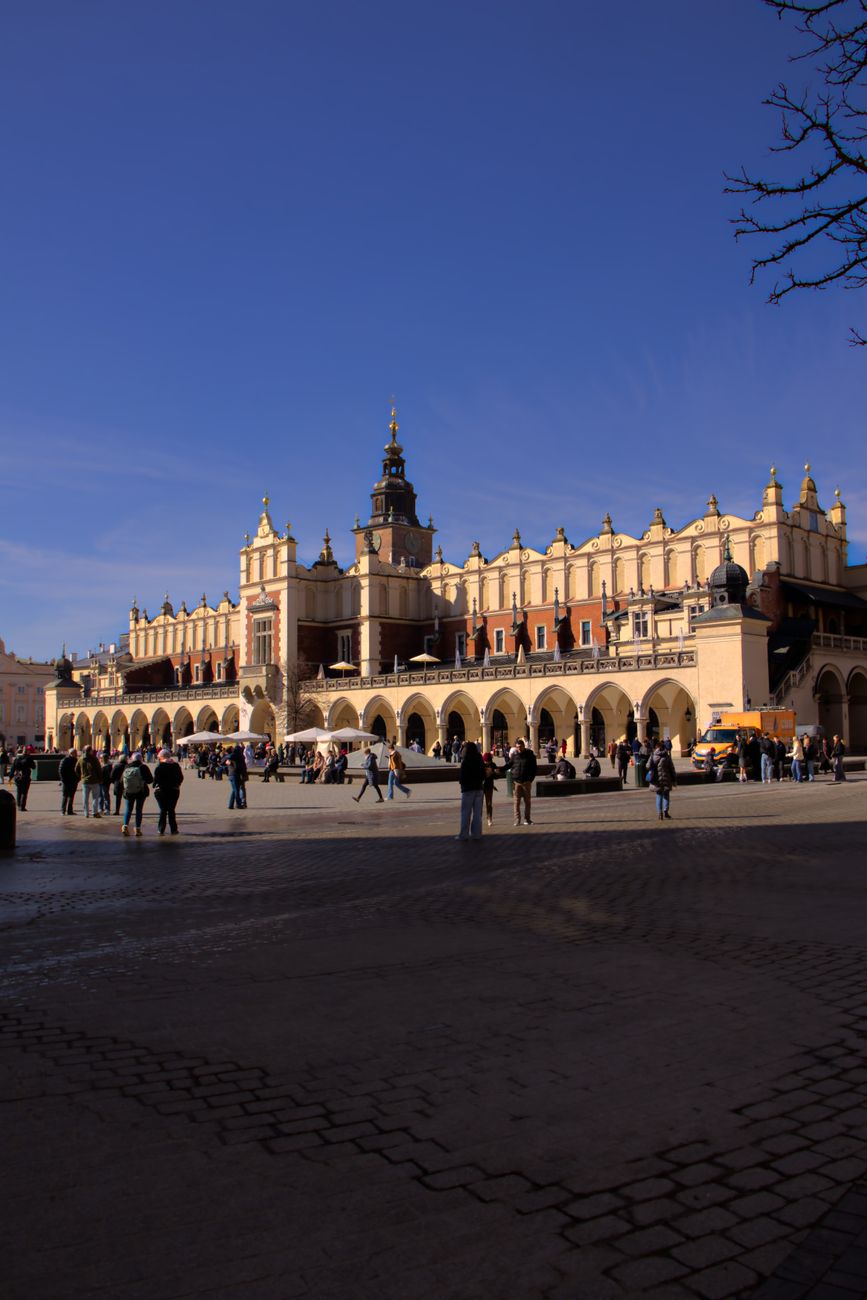
Kraków’s Main Market Square (Rynek Główny) is one of the largest medieval market squares in Europe and the natural starting point for any tour. At its centre stands the Cloth Hall (Sukiennice), a Renaissance structure that once housed the city’s cloth merchants and now contains souvenir stalls on the ground floor and a branch of the National Museum above.
A guided walk from the square typically covers: the exterior of St Mary’s Basilica and the hourly trumpeter signal from its taller tower (a tradition dating to the 13th century); the underground Rynek Museum (entry approximately PLN 24); the Planty park that replaced the city walls; and the approach to Wawel Hill. Most walking tours last 2–3 hours and include the Old Town and Kazimierz as separate sections.
Good for: First-time visitors wanting historical orientation before exploring independently.
Operators include Cracow City Tours (cracowcitytours.com) and Free Walking Tour Krakow (Rynek Główny departure, tip-based, multiple daily departures). English-language departures typically at 10am and 2pm.
Wawel Castle & Cathedral
Price: Cathedral approximately PLN 15 (free on Sunday mornings); Royal Chambers approximately PLN 35 (around €8); guided tours approximately PLN 50–80 extra per person | Duration: 2–3 hours | Note: Timed-entry tickets required for Royal Chambers
Wawel Royal Castle was the seat of Polish kings from the 11th century until the court moved to Warsaw in 1596. The hill on which it stands has been occupied since the Palaeolithic period, and layers of archaeology from different centuries are visible in the foundations. The Cathedral — where 36 Polish kings were coronated and most are buried — is one of the most historically significant buildings in the country.
A licensed guide at Wawel covers the State Rooms and Royal Private Apartments (different ticket), the treasury (including the coronation sword Szczerbiec and regalia), the Dragon’s Den cave beneath the hill, and the Cathedral crypt where Tadeusz Kościuszko, Adam Mickiewicz, and marshals of modern Poland are interred.
What to know: Royal Chambers tickets sell out — book via wawel.krakow.pl before you arrive. Sunday mornings in the Cathedral are free but Mass is in progress, so guided tours don’t operate then. The Dragon’s Den is accessible independently without a guide (entry PLN 9) and is worth 20 minutes.
Kazimierz — Jewish Quarter Tour
Price: From approximately €20–30 per person | Duration: 2.5–3 hours
Kazimierz was Kraków’s Jewish district from the late 15th century until World War II. At its peak in 1939, around 65,000 Jews lived in Kraków — most were murdered during the occupation or deported to the Bełżec and Auschwitz-Birkenau extermination camps. Kazimierz today is one of the best-preserved Jewish districts in Central Europe, combining active synagogues, a thriving restaurant and café scene, and memorial spaces.
Guided tours cover: the Old Synagogue (now a Jewish Museum, ul. Szeroka 24 — entry approximately PLN 20); the Remuh Synagogue and cemetery (one of the few remaining functioning synagogues, ul. Szeroka 40); the Galicia Jewish Museum (ul. Dajwór 18, focusing on the Holocaust and survivor stories); and Plac Nowy market square, the neighbourhood’s social centre.
Combine with a visit to Schindler’s Factory (ul. Lipowa 4, entry PLN 32), which covers the German occupation of Kraków using interactive exhibitions and original documents, and the adjacent Museum of Contemporary Art Kraków.
Auschwitz-Birkenau Day Trip
Why This Is Kraków’s Most Important Excursion
The Auschwitz-Birkenau Memorial and Museum, 70km west of Kraków in Oświęcim, is the largest and best-preserved Nazi concentration and extermination camp complex. Approximately 1.1 million people — the majority Jewish — were murdered there between 1940 and 1945. It is a UNESCO World Heritage Site and receives around 2.3 million visitors annually.
Entry: Free (Memorial does not charge for entry) Guided tour at Auschwitz I: Required during peak hours (10am–4pm); approximately PLN 85 per person at the Memorial (licensed Memorial guide) Transport from Kraków: Buses run from Galeria Krakowska (MDA bus line) for approximately PLN 18–25 return. Organised tours include transport: approximately PLN 100–150 for Auschwitz I only, PLN 160–250 for both camps
What the Tour Covers
A standard guided tour at Auschwitz I (the main camp) lasts approximately 3.5 hours and covers 16 blocks. Block 4 contains the exhibition of evidence including human hair, shoes, and personal belongings. Block 11 is the Punishment Block — the starvation cell where Maximilian Kolbe died, and the wall where executions were carried out.
The gas chamber and crematorium at Auschwitz I (the original, smaller installation) is included. Birkenau (Auschwitz II), 3km from the main camp, is where the majority of the murder took place — it operated four large crematoria and gas chambers capable of processing thousands of people per day. The Birkenau site is vast (170 hectares) and requires separate time; tours that include both camps run 9–10 hours total from Kraków.
Practical notes:
- Dress respectfully — no shorts or sleeveless tops inside the blocks
- Photography is permitted everywhere except Block 11’s basement
- Allow time for the Birkenau pond memorial area where victims’ ashes were deposited
- Do not bring large bags (lockers available at the entrance for free)
- Guided tours in English depart at set times — pre-book via auschwitz.org or through an operator for the guaranteed time slot
Browse Auschwitz guided tours from Kraków to compare operators and departure times before booking.
Wieliczka Salt Mine Tour
Entry price: Approximately PLN 109–129 for the Tourist Route (around €24–28) as of 2026 | Distance from Kraków: 14km south-east (25 minutes by minibus or public bus) | Duration: 2.5–3 hours underground + travel time
The Wieliczka Salt Mine has been in continuous operation since the 13th century, making it one of the oldest industrial sites in Europe. The UNESCO-listed site extends 327km of tunnels across 9 levels to a depth of 327 metres below ground. The Tourist Route covers the upper three levels (depth 64–135 metres).
The main draw is the Chapel of St Kinga — a fully underground church carved entirely from rock salt, with chandeliers, bas-relief panels, and a floor of polished salt crystals. The chapel took over 30 years to complete and can seat around 400 people; it is still used for Mass and occasionally concerts.
What tours include: Licensed mine guides are included in the entry fee — all visits on the Tourist Route proceed with an assigned guide, typically in groups of 20–30. The guide covers the mining history, explains how salt was extracted by hand over centuries, and leads the group through the chain of chambers.
Transport: Minibus services from Kraków’s Old Town (various operators, approximately PLN 20–30 return including the minibus and meeting point coordination) are more practical than public buses, which require a connection in Wieliczka town. Organised tours from Kraków cost approximately PLN 130–160 per person total (transport + entry).
Booking: The Mine sells out in summer — book at wieliczka-saltmine.pl or through an operator at least 1 week ahead for July–August visits. Morning slots (8am–10am) have smaller groups.
Nowa Huta — Communist Architecture Tour
Price: From approximately €15–25 per person | Duration: 2–3 hours (most tour use the tram)
Nowa Huta, built from 1949 as a model socialist city for workers at the Lenin Steelworks, is one of the best-preserved examples of Socialist Realist urban planning in Europe. It sits 10km east of Kraków’s Old Town and is accessible by tram 4 or 22 from Plac Centralny.
Guided tours cover Central Square (Plac Centralny) — an oval plaza flanked by Soviet-era tenements with arcaded ground floors — the steelworks (now ArcelorMittal, with a separate industrial museum), the Lord’s Ark Church (built as an act of defiance during communist rule), and the Solidarity monument. Many tours include a vintage Trabant or Fiat 125p for atmosphere.
This tour makes most sense paired with an Old Town visit to give context about the ideological contrast the communist planners intended: Nowa Huta was built as an atheist industrial counterweight to the royal, Catholic, aristocratic city of Kraków.
Practical Booking Tips
Peak season (June–August): Auschwitz tours sell out weeks ahead — book immediately on arrival in Kraków, or ideally before you travel. Wieliczka Salt Mine also books out; the 8am entry is your best chance of a same-week slot without advance booking. Everything else can typically be arranged 1–2 days ahead.
Off-peak (November–March): Auschwitz and Wieliczka are far less crowded. Auschwitz is arguably more atmospheric in winter — the scale of Birkenau particularly. Wieliczka doesn’t change with the seasons.
Group sizes: Most small-group operators cap at 15 people. Private guides offer full-day packages covering Auschwitz and either Wieliczka or Nowa Huta for approximately €150–200 per group (not per person), making private tours cost-effective for parties of 3 or more.
Tour combinations: The most popular 3-day structure from Kraków is Old Town + Wawel (Day 1), Auschwitz (Day 2, full day), Wieliczka + Kazimierz (Day 3, morning mine, afternoon walking tour). This order works well because the heaviness of Auschwitz sits between the lighter sightseeing days.
Browse Kraków guided tours to compare operators, read reviews, and book with flexible cancellation.