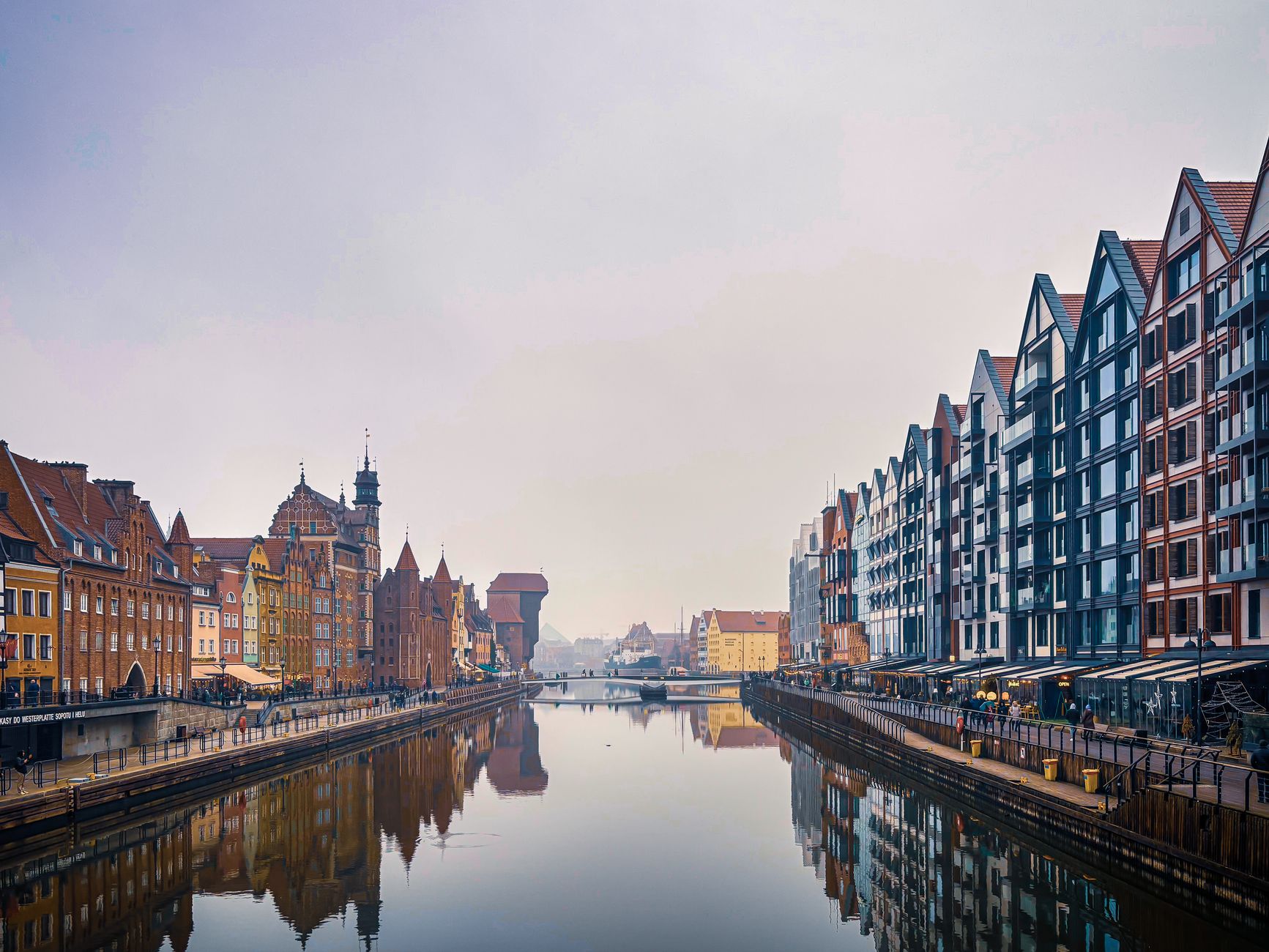
Gdańsk stands at a remarkable intersection of history. This Baltic port city was one of the wealthiest trading cities in medieval Europe, was flattened and then rebuilt after World War II, and in 1980 became the birthplace of Solidarity — the trade union movement that began the unravelling of communism across Eastern Europe. Guided tours here open up layers of the city that aren’t obvious from street-level sightseeing. This page covers the best options across Old Town walks, Westerplatte history, amber district tours, Baltic excursions, and day trips.
Old Town & Long Market Walking Tours
Long Market (Długi Targ) Historic Walk
Price: From approximately €15–20 per person (small group) | Duration: 2–3 hours | Highlights: Długi Targ, Neptune Fountain, Artus Court, Green Gate, Crane (Żuraw), Mariacka Street
The Long Market (Długi Targ) is Gdańsk’s central pedestrian axis — a sequence of merchant-house facades running from the Golden Gate to the Green Gate, with the Motława River at its east end. Unlike Warsaw’s Old Town, Gdańsk’s historic centre was not comprehensively reconstructed but rather rebuilt to closely match pre-war photos and architectural records; some original fabric survived, particularly in the foundations and cellars.
A guided walk typically covers:
- The Neptune Fountain (1633) — a bronze sea god that has become Gdańsk’s unofficial symbol; guides note that Gdańsk gin was historically poured into the fountain during celebrations
- Artus Court (Dwór Artusa) — entry approximately PLN 20; the building served as the merchants’ trading and social club from the 14th century; the interior has one of the finest tiled stoves in Northern Europe
- The Crane (Żuraw) — a 15th-century medieval port crane on the Motława riverbank, now part of the National Maritime Museum (entry approximately PLN 25); guides explain how it was used to load and unload cargo from Baltic trading ships
- Mariacka Street — the amber jewellery street, lined with terraced steps and gargoyle rain-spouts; tours typically explain the amber trade here before or after visiting specialist shops
Good for: First-time visitors, architecture and history enthusiasts, anyone who wants context on Gdańsk’s Hanseatic merchant heritage before exploring independently.
Operators include Gdańsk Free Walking Tour (Długi Targ departure, tip-based) and Gdańsk Guided Tours (gdanskguidedtours.com). English departures at 10am and 2pm daily April–October; reduced frequency November–March.
Amber District & Mariacka Street Tour
Price: From approximately €15–25 per person | Duration: 2 hours
Gdańsk is the world’s historic centre of the amber trade. The Baltic coast holds the world’s largest known amber deposits, and the city’s goldsmiths and jewellers have worked with Baltic amber for centuries. The amber district tour concentrates on Mariacka Street and the surrounding workshops, covering how amber is graded (by transparency, colour, and inclusion quality), the difference between genuine Baltic amber and modern fakes, and how to identify legitimate pieces before purchasing.
Guides typically arrange access to an amber workshop where visitors see cutting, polishing, and setting processes. Baltic amber is classified by colour (pale straw yellow through to deep cognac and rare green) and by the presence of inclusions — prehistoric insects, plant material, and air bubbles preserved in the resin. Pieces with insect inclusions command substantially higher prices.
What to know: Genuine Baltic amber carries a certificate of origin. Pressed amber (reconstituted chips, common in cheaper markets) and plastic fakes are both widespread in Gdańsk tourist shops. The tour covers how to distinguish between them: genuine amber is warm to the touch, lighter than glass of equivalent size, and does not produce a chemical smell when rubbed. Buy from amber guild-member shops for the most reliable provenance.
Westerplatte — Where World War II Began
Westerplatte History Tour
Price: From approximately PLN 80–120 per person (including water tram or bus transport) | Duration: 3–4 hours round trip | Site entry: Free
At 4:47am on 1 September 1939, the German battleship Schleswig-Holstein opened fire on the Polish Military Transit Depot at Westerplatte — the first military action of World War II. A garrison of approximately 180 Polish soldiers held the position for 7 days against German forces of around 3,500 before surrendering. The defence has been central to Polish national memory of the war ever since.
The Westerplatte peninsula today is a memorial park. Key sites on a guided tour include:
- The ruins of the main guardhouse (Wartownia Nr 1) — the most photographed structure, its concrete walls still showing shell damage from 1939
- The monument to the defenders — a 25-metre granite mast erected in 1966, visible from the water approach
- The cemetery — where 15 Polish soldiers who died in the defence are buried alongside a small number of German soldiers
- The Command Barracks ruins — which burned during the assault; guides reconstruct the 7-day timeline of the defence using archive photographs
Water tram (most scenic): Departs from Green Gate on Długi Targ, runs from May to September, approximately PLN 19 one-way, 25 minutes. The approach by sea — with the monument coming into view above the treeline — is historically evocative. Return by the same route or by bus 106.
Organised tours: Private minibus tours from the Old Town cost approximately PLN 80–100 per person and include a guide at Westerplatte. Most English-language tours depart at 10am and 2pm from the waterfront near the Green Gate.
European Solidarity Centre Tours
Price: Museum entry approximately PLN 30 (around €7) | Address: pl. Solidarności 1 (within walking distance of the shipyard gates) | Duration: 2–3 hours
The European Solidarity Centre (Europejskie Centrum Solidarności) opened in 2014 near Gate 2 of the former Lenin Shipyard — the site of the 1980 strikes that produced the Solidarity trade union. The museum covers the entire arc of the movement: the 1970 worker protests in Gdańsk (violently suppressed), the 1980 strikes and the August Agreements, the 16 months of legal Solidarity activity before martial law in December 1981, underground resistance through the 1980s, and the 1989 Round Table negotiations that led to the first semi-free elections in communist Poland.
The building’s interior uses raw Corten steel panels; the archive of Solidarity documents and original strike photographs is one of the most significant in Poland. A licensed guide adds considerably to the experience — the museum is dense with period political context that doesn’t translate well without explanation. English-language guided tours typically run at 11am and 2pm and must be pre-booked.
Combine with: The original shipyard Gate 2 and the Three Crosses Monument (outside the museum), which marks the spot where the 1970 victims fell.
Baltic Sea Boat Tours
Price: From approximately PLN 40–80 per person depending on duration | Duration: 1–3 hours | Departures: Green Gate waterfront, May–September
Short boat tours on the Motława River and into Gdańsk Bay operate from the Green Gate waterfront throughout summer. Routes typically include the full length of the historic waterfront, the Granary Island (Ołowianka) with the Philharmonic Hall and music museums, and a turn into the outer harbour to view the modern container port before returning.
Longer excursions (2–3 hours) sail to Westerplatte by sea and include the memorial site visit, combining transport and historical content. Evening sunset cruises with drinks operate mid-June to mid-August from approximately PLN 60–80 per person. Ferries to Hel Peninsula (1.5 hours) run from the same waterfront but are transport services rather than guided tours.
Day Trips from Gdańsk
Malbork Castle
Distance: 55km south-east of Gdańsk | Train: Approximately 35–40 minutes from Gdańsk Główny; trains every 30–60 minutes | Entry: Approximately PLN 70–90 (around €15–20), including an audio guide | Duration: Half-day or full day
Malbork Castle is the largest castle in the world by land area — a massive Teutonic Order fortress built in red brick from 1274, expanded extensively in the 14th century, and used as the Grand Master’s seat from 1309 to 1457. It is a UNESCO World Heritage Site and one of the best-preserved medieval fortresses in Europe.
Guided tours at the castle cover three connected castle sections: the Lower Castle (service buildings and the St Lawrence Church), the Middle Castle (the Great Refectory and Grand Master’s chambers), and the High Castle (the knights’ dormitory, chapter house, and latrine tower — an architectural novelty of medieval sanitation). Entry includes an audio guide in English; licensed human guides can be booked on-site for approximately PLN 120–150 extra.
How to book: Buy tickets at bilety.zamek.malbork.pl in advance for summer visits. The castle receives over 500,000 visitors annually; July–August queues at the gate can be 30–45 minutes without pre-booking. A mid-week morning slot in September or October gives the best experience with smaller crowds.
By tour from Gdańsk: Organised coach tours from Gdańsk’s Old Town cost approximately PLN 100–130 per person including transport and guide; they typically depart at 9am and return by 4pm, leaving time for the castle’s multiple sections without rushing.
Sopot & Gdynia — Tri-City Tour
Price: From approximately €25–40 per person (guided); or independently by SKM commuter rail from PLN 6 one-way | Duration: Full day
Sopot is 12km north of Gdańsk by rail — 15 minutes on the SKM commuter train (services every few minutes in peak hours). The resort town is famous for its wooden pier (Molo), the longest in the Baltic at 516 metres, entry approximately PLN 10; the Grand Hotel (operating since 1927, exterior viewable freely); and the pedestrian ul. Bohaterów Monte Cassino (“Monciaki”), lined with bars and restaurants.
A Tri-City guided tour (Gdańsk → Sopot → Gdynia) takes in the Sopot pier and beach resort character, then continues to Gdynia — a purpose-built inter-war city created when Poland regained access to the sea after 1918 and needed a commercial port not controlled by the League of Nations mandated Free City of Danzig. Gdynia’s modernist inter-war architecture (1920s–1930s) and its naval museum ships (ORP Błyskawica destroyer, ORP Orzeł submarine) are covered on most Tri-City tours.
Practical Booking Tips
When to book: Westerplatte water tram tours and Malbork Castle tickets should be reserved at least 3–4 days ahead in July–August. Old Town walking tours rarely need advance booking.
Weather: Gdańsk is a coastal city — bring a light waterproof jacket even in summer. Baltic weather can change rapidly, and most walking tours operate regardless of rain.
Transport card: The MEVO city bike scheme and the SKM commuter rail cover most of the Tri-City area; a 24-hour SKM pass (approximately PLN 21) allows unlimited travel to Sopot and Gdynia and makes self-guided day trips easy.
Language: English tours run daily from April to October. Outside summer, phone ahead to confirm English availability — Westerplatte and Solidarity Centre English slots are less frequent November–March.
Browse Gdańsk guided tours to compare current operators, departure times, and prices.