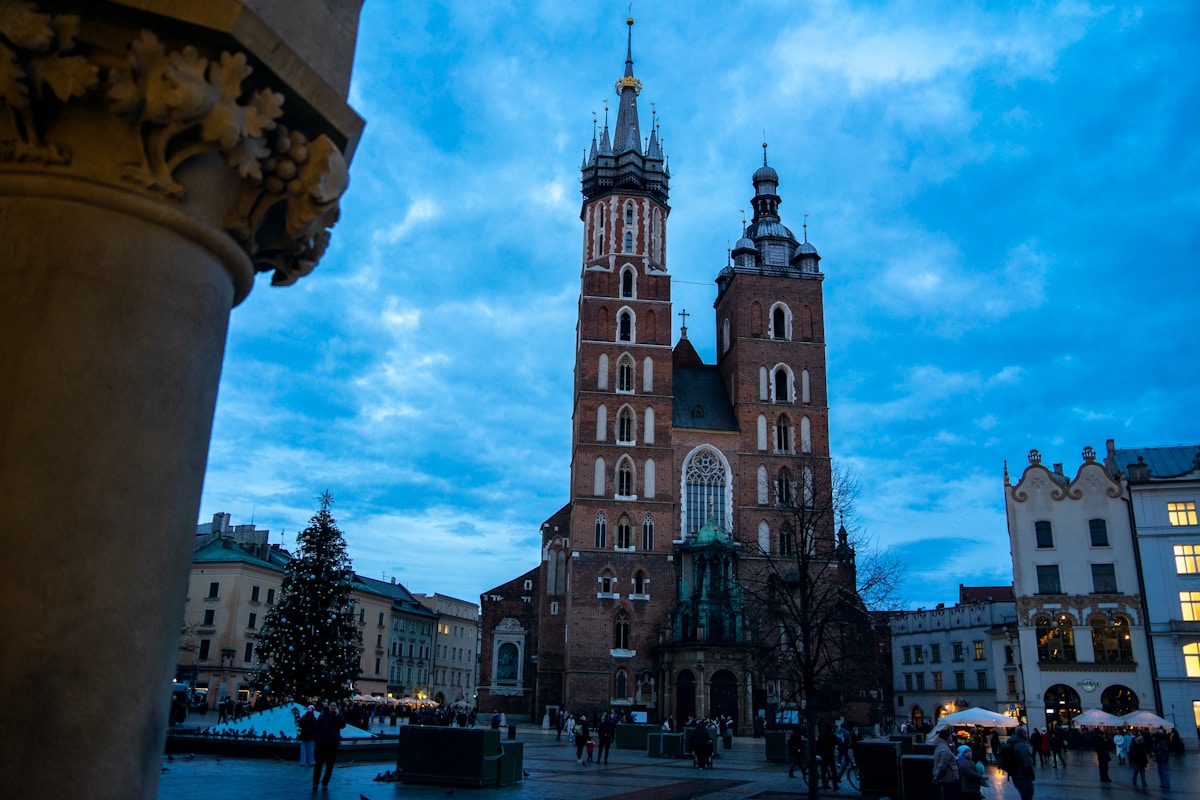
Poland punches well above its weight when it comes to Christmas markets. The combination of medieval squares, Gothic architecture, and a genuine folk craft tradition produces markets that feel different from their German or Austrian counterparts - less corporate, more rooted in regional identity. Wrocław’s Jarmark Bożonarodzeniowy regularly appears at the top of European rankings. Kraków’s market inside Rynek Główny is staged in one of the continent’s most beautiful squares. And Warsaw, Gdańsk, and Poznań each bring something distinct.
This guide covers all five major markets with the practical detail you need: typical dates, location, what to eat, what to buy, and opening hours. For broader advice on visiting Poland in December - weather, packing, transport - see our December travel guide.
Kraków: Rynek Główny Market
2026 dates: 27 November 2026 – 6 January 2027
Location: Rynek Główny (Main Market Square), Old Town
Opening hours: Daily 10:00–20:00 (food stalls often until 22:00)
Kraków’s market sets up directly on Rynek Główny, the largest medieval town square in Europe, with the Sukiennice (Cloth Hall) running through its centre and St Mary’s Basilica at the corner. The setting alone makes it worth the trip: at dusk, when the market lights compete with the illuminated Gothic towers, the square becomes something memorable.
What to eat
- Oscypek - the defining Polish Christmas market food. Oscypek is a smoked sheep’s cheese from the Tatra highlands, shaped in decorative wooden moulds. At Kraków’s market it’s grilled over open flame and served with cranberry jam (żurawina). Price: around 10–15 PLN per piece.
- Grzaniec - Polish mulled wine, slightly different from the German Glühwein, often made with local herbs and honey. From 12–18 PLN a cup.
- Pierogi - look for the boiled-then-pan-fried kind: crisp on the outside, soft within. Fillings at Christmas markets lean toward ruskie (potato and cheese) or mushroom-sauerkraut. Around 20–35 PLN for a plate of six.
- Obwarzanek krakowski - Kraków’s ring-shaped street bread, topped with sesame or poppy seeds. This one’s available year-round but especially atmospheric in the winter market context. Around 3–4 PLN.
- Bigos - the classic Polish hunter’s stew, sauerkraut and meat slow-cooked for hours. A warming bowl runs 20–30 PLN.
What to buy
Kraków’s market has a stronger craft component than most. Look for:
- Hand-painted glass ornaments - distinctive Kraków-style designs, from around 25–60 PLN per piece
- Szopki krakowskie - miniature Kraków nativity scenes built in intricate Gothic-cathedral style. Authentic pieces are expensive (200–1,000+ PLN) but smaller decorative versions start around 50 PLN
- Wooden folk art - painted boxes, figures, and decorative items from the Małopolska region
- Linen and embroidery - tablecloths and runners with traditional regional patterns
For themed walking tours of the market and Old Town in December, see guided tours of Kraków.
Warsaw: Old Town and Royal Castle Market
2026 dates: approximately 20 November 2026 – 5 January 2027
Location: Plac Defilad (main market) and the Old Town Market Square (Rynek Starego Miasta)
Opening hours: Daily, approximately 11:00–21:00 (extended on weekends)
Warsaw operates two complementary Christmas markets within walking distance of each other. The main market clusters around Plac Zamkowy, directly in front of the Royal Castle - the red-brick castle forms a dramatic backdrop, particularly at night. The separate market in Rynek Starego Miasta (the Old Town Square) is smaller and tends to have a more artisan, less commercial character.
Both areas are part of Warsaw’s UNESCO-listed Old Town, reconstructed after near-total destruction in World War II. The context adds meaning: this city celebrates Christmas with a particular intention.
What to eat
- Żurek - Poland’s distinctive sour rye soup, served in a bread bowl at several market stalls. Rich, warming, unusual. Around 20–30 PLN.
- Kielbasa grillowa - grilled Polish sausage, served in a bread roll with mustard and sauerkraut. Around 15–20 PLN.
- Grzaniec and hot cider - mulled wine is everywhere, but some Warsaw stalls serve hot apple cider (cydr) as an alternative, particularly popular with families.
- Pierniki - honey gingerbread, traditionally from Toruń (see below) but sold throughout Poland at Christmas. Often decorated elaborately.
What to buy
- Amber jewellery - Poland is the Baltic’s leading amber producer, and Warsaw’s markets carry a wide selection. Budget pieces start around 80–150 PLN; quality pendants and rings run 300–800 PLN. Buy from stalls with certification to avoid synthetic imitations.
- Wooden toys - handmade and painted in the Polish folk tradition
- Pottery - including pieces from the Bolesławiec (Bunzlau) tradition, though more of this appears at Wrocław’s market
For guided festive tours of the Old Town and Christmas markets, see guided tours of Warsaw.
Wrocław: Jarmark Bożonarodzeniowy
2026 dates: 20 November 2026 – 7 January 2027 (closed 24–25 December and 1 January)
Location: Rynek (Market Square) and surrounding streets
Opening hours: Daily 10:00–21:00 (extended hours on selected evenings)
Wrocław’s Jarmark Bożonarodzeniowy is consistently rated one of the best Christmas markets in Europe - it has won the European Best Destinations award for Christmas markets multiple times and regularly appears in the top five on the continent. This is not hype. The market is genuinely excellent.
What sets it apart: the combination of a large, strikingly beautiful Market Square (one of the biggest in Central Europe), hundreds of wooden stalls built in a traditional Germanic style, and an exceptionally strong craft and food programme. The Old Town Hall stands at the centre of the Rynek, illuminated throughout December. Gnome statues - Wrocław’s city mascot, the krasnal - appear throughout the market in festive incarnations.
The market occupies the Rynek itself plus extends along Świdnicka Street and into several adjacent squares. Allow at least three hours to cover it properly.
What to eat
- Oscypek - present here too, but Wrocław also has stalls selling Silesian regional specialities that you won’t find in Kraków or Warsaw
- Sauerkraut and mushroom dumplings - the Silesian tradition leans heavily on these flavours
- Bratwurst and Silesian-style sausages - Wrocław’s history as the German city of Breslau shows in the market food; the grilled sausage stalls here have a different flavour profile from the Warsaw or Kraków versions
- Grzaniec with Silesian herbs - several stalls produce their own blends
What to buy
- Bolesławiec pottery - this distinctive blue-and-white Polish stoneware, produced 90 km from Wrocław, is easier to find here than anywhere else in Poland. A mug starts around 60–100 PLN; sets run much higher.
- Glass baubles and ornaments - Wrocław’s market has an excellent selection of hand-blown glass
- Leather goods - belts, wallets, and bags from artisan leather workers
- Regional honeys and spirits - producers from Lower Silesia bring infused honeys and nalewka (Polish fruit liqueurs)
Gdańsk: Winter Market at Artus Court
2026 dates: 20 November – 23 December 2026
Location: Targ Węglowy (Coal Market) and Długi Targ (Long Market)
Opening hours: Sunday–Thursday 12:00–20:00, Friday–Saturday 12:00–21:00
Gdańsk’s Christmas market occupies Długi Targ, the historic main street of the Old Town that runs down to the Motława River. The setting is Baltic Gothic - tall narrow merchant houses, the Green Gate, the Neptune Fountain - and the amber trade that made Gdańsk rich for centuries is still very much present in the market stalls.
The market is smaller than Kraków or Wrocław but distinctive in character. The Baltic influences are clear: amber dominates the craft stalls, fish features heavily in the food, and there’s a northern quality to the atmosphere that feels different from inland Poland.
What to eat
- Śledzie - pickled herring, a Baltic staple, served in several ways at market stalls. Particularly good with onion and cream.
- Grilled fish - Gdańsk’s coastal position means smoked and grilled fish appear at Christmas markets here in ways they don’t elsewhere in Poland
- Grzaniec - the mulled wine here sometimes incorporates Baltic-inspired spice blends
What to buy
- Amber - Gdańsk is the amber capital of Europe and the best place in Poland to buy it. The market has dozens of amber stalls. Prices start around 30–50 PLN for small pieces; fine jewellery pieces run 500–3,000+ PLN. Look for genuine Baltic amber (bałtycki bursztyn) and avoid synthetic resin imitations.
- Sailor-themed gifts and decorations - Gdańsk’s maritime identity comes through in the craft items
- Pressed flower art - a local artisan tradition
Poznań: Jarmark Świętego Marcina
2026 dates: From around 20 November 2026 through 31 December 2026 (Poznań’s market runs one of the longest seasons in Poland; exact start confirmed in November)
Location: Stary Rynek (Old Market Square) and Plac Wolności
Opening hours: Daily, approximately 10:00–20:00
Poznań is the odd one out in this list. Its Christmas market culture is real and well-established, but the city is also famous for its St Martin’s Day market in November, which bleeds directly into the Christmas season. The result is a longer, more embedded festive market tradition than anywhere else in Poland.
The Stary Rynek is Poznań’s main stage: a large, attractive Renaissance square with the Town Hall at its centre. The market here has a slightly different energy from the tourist-heavy Kraków and Wrocław versions - Poznań is a major Polish city with a large student population, and the Christmas market attracts locals as much as visitors.
What to eat
- Rogal świętomarciński - Poznań’s iconic St Martin’s croissant, filled with white poppy seed paste, nuts, and dried fruit. This is the city’s signature baked good, protected by EU geographical indication. During the festive market season, every bakery stall sells them. Around 8–15 PLN each.
- Grzaniec and hot chocolate - Poznań’s market has a strong hot drink culture
- Pyry z gzikiem - potatoes with cottage cheese and chives, a Poznań regional speciality that appears at winter markets
What to buy
- Ceramics and pottery - local artisan producers
- Wooden decorations - traditional Wielkopolska (Greater Poland) folk craft style, distinct from the Małopolska style found in Kraków
- Local food products - honey, jams, and preserves from the Poznań region
Where to Stay for the Christmas Markets
Accommodation in Old Town locations fills fast from October onward for December dates. Book at least 6–8 weeks ahead for Kraków and Wrocław peak weeks (12–23 December).
Kraków
Hotel Wentzl sits directly on Rynek Główny at number 19 - the only hotel with windows overlooking the Christmas market from above. Rooms from approximately 700–1,200 PLN per night in December. It books up months in advance for peak Christmas dates.
The Bonerowski Palace is a 5-star boutique hotel in a 17th-century restored building at Rynek Główny 42, with the market stalls 60 seconds from the front door. Suites from approximately 900–1,500 PLN in December.
Radisson Blu Hotel Krakow on ul. Straszewskiego, 7 minutes’ walk from Rynek Główny, offers 196 rooms, a spa, and bar with Old Town views. December rates from approximately 500–850 PLN. A practical option for travellers who want full-service chain-standard accommodation.
For a broader selection across Kraków neighbourhoods, see our Kraków accommodation guide.
Warsaw, Wrocław, Gdańsk, and Poznań
For the other four cities, browse our city-specific accommodation pages:
Practical tips for visiting Polish Christmas markets
Best time to visit
The first two weeks of December strike the best balance: markets are fully operational, temperatures are cold but not extreme (typically -2°C to 4°C in the daytime), and crowds are manageable on weekdays. The final weekend before Christmas (21–23 December) is the busiest period across all five cities.
If you’re combining multiple cities, Kraków–Wrocław makes the most natural pairing (2.5 hours by intercity train). Guided Christmas market tours across Poland are a convenient option if you want transport and itinerary organised between cities. Warsaw–Gdańsk is a second strong combination (3 hours by express train). Poznań sits between Warsaw and Berlin on the main rail corridor and works well as a day trip or overnight from either direction.
What to wear
Temperatures at Polish Christmas markets range from -5°C to 5°C through December. Waterproof boots are essential - cobblestones get slippery with ice and slush. Thermal layers, a proper winter coat, gloves, and a hat are not optional. The markets are outdoor and the evenings can be genuinely cold.
Budget planning
Polish Christmas markets are significantly more affordable than German, Austrian, or Czech equivalents. A full evening at the market - dinner, two or three drinks, a gift or two - typically runs 100–250 PLN (roughly €25–60) per person. Accommodation in the Old Towns costs more during the December period; book at least six weeks ahead for Kraków and Wrocław, where rooms fill quickly.
Payment
Most market stalls are cash-only or prefer it. Bring PLN in small denominations (10s and 20s). ATMs are widely available near all five markets.
For full information on getting around Poland and visiting in the winter season, see our December travel guide.