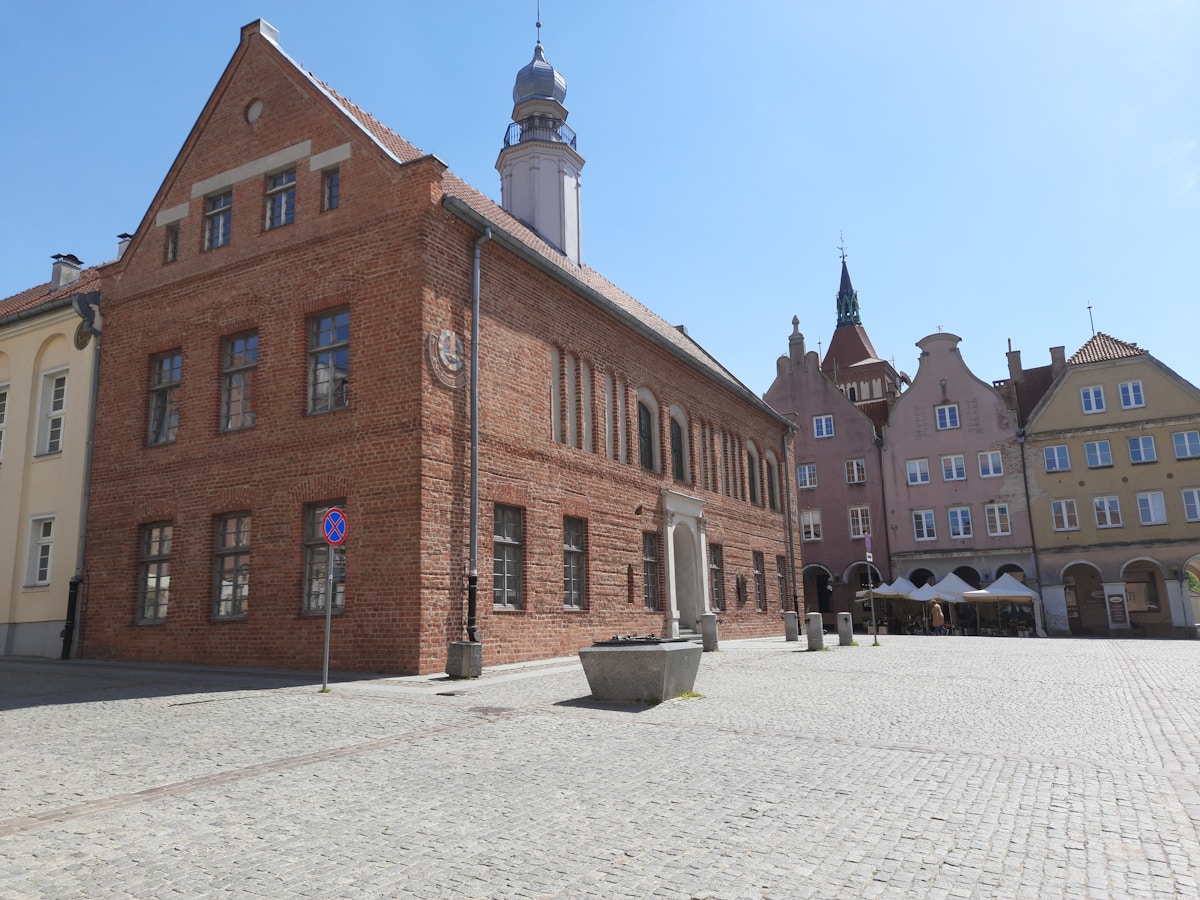
Olsztyn is the capital of the Warmia-Masuria region, a city of about 170,000 that functions as the natural gateway to the Masurian Lake District - Poland’s largest lake region and one of the most visited natural areas in the country. The city itself has a genuinely good historic core: a Teutonic castle that Copernicus called home for five years, a compact Gothic Old Town, and a lively market square that works well as a base for both urban exploration and lake-country excursions.
Olsztyn Castle and the Copernicus Connection
The Teutonic Castle (Zamek Kapituły Warmińskiej) above the Łyna River is the city’s centrepiece. Built by the Teutonic Knights in the 14th century, it became the administrative seat of the Warmia chapter and the residence of Nicolaus Copernicus between 1516 and 1521. Copernicus used the castle not only as his office but as an observatory - scratching marks into the south gallery wall to track the sun’s angle and refine his astronomical calculations.
The castle now houses the Museum of Warmia and Masuria, covering the region’s history from the Teutonic period through to the 20th century. The Copernicus exhibition includes the original wall markings. Entry costs approximately 18 PLN / €4 for adults as of 2026. Open Tuesday to Sunday, 10:00–18:00 in summer; reduced hours in winter.
Old Town
Olsztyn’s Stare Miasto is one of the better-preserved Old Towns in northeastern Poland. The High Gate (Brama Wysoka), a Gothic brick gatehouse from the 14th century, marks the entry from the modern centre. Inside, the Old Town Market Square (Rynek Starego Miasta) is bounded by colourful burgher houses, several of which now house restaurants and cafés under outdoor terraces.
The Cathedral of St. James (Katedra Świętego Jakuba) is the dominant building - a Gothic brick basilica begun in 1380 and extended in subsequent centuries. The interior is spacious with well-preserved Gothic vaulting and several notable altars. Entry is free; dress modestly.
The Warmia and Masuria Regional Museum in the town hall building covers folk craft, natural history, and local ethnography. Combined with the castle museum, it fills a day’s sightseeing comfortably.
The Łyna River and Park System
The Łyna River flows through the city and the green corridors along its banks form the backbone of Olsztyn’s extensive park system - around 30% of the city’s area is green space, an unusually high figure for a Polish regional capital. The Jakubowo Park north of the Old Town and the Forest District to the west are both accessible on foot or by city bike (Bike_S system, from approximately 2 PLN / €0.50 per 20 minutes as of 2026).
The riverside walk from the castle down to Jakubowo Park takes about 30 minutes at a casual pace and passes through mature woodland that feels surprisingly remote for a city centre.
Warmia Open-Air Museum
The Museum of Folk Architecture in Olsztynek (Muzeum Budownictwa Ludowego) - 25 km south of Olsztyn - is one of the best skansen (open-air folk museums) in Poland. More than 60 traditional Warmian and Masurian buildings have been relocated to the site, including farmhouses, granaries, a water mill, and a Lutheran church from the 17th century. Entry approximately 20 PLN / €5 as of 2026. The museum is best reached by car or PKS bus.
Day Trips into the Masurian Lakes
The Great Masurian Lakes - a chain of interconnected lakes navigable by boat, canoe, and kayak - start around 80–100 km east of Olsztyn. Guided tours from Olsztyn cover the Wolf’s Lair and the main Masurian lake resorts, which is a good option if you don’t have a car. The main resort towns are Mikołajki (on Lake Śniardwy, Poland’s largest lake) and Giżycko (on Lake Mamry). From Olsztyn, PKS buses and regional trains serve both towns with journey times of 90 minutes to 2 hours.
In summer, boat cruises on the Masurian lakes run from Mikołajki pier from approximately 50–100 PLN / €12–23 as of 2026 depending on route length. Kayak rental is available from most lakeside centres at approximately 40–60 PLN / €9–14 per day as of 2026.
The Wolf’s Lair (Wilczy Szaniec) at Gierłoż, 130 km east, is within range as a full-day excursion. Hitler’s eastern command bunker complex, blown up by retreating German forces in 1945, is left in ruin and is now an outdoor museum. Entry approximately 30 PLN / €7 as of 2026.
Getting Around Olsztyn
The city has a functioning tram network - one of the more unusual features of a city this size - supplemented by buses. A single tram or bus ticket costs approximately 3.60 PLN / €0.84 as of 2026. Most Old Town sights are walkable from the main station, but the tram is useful for reaching the western parks.
Search hotels in Olsztyn on Booking.com
More in Olsztyn
- Olsztyn City Guide - overview, restaurants, hotels, and getting there
- Where to Stay in Olsztyn - hotels and hostels for the lake district
- Food to Try in Olsztyn - Warmian cuisine and lake district dishes
- Kayaking the Masurian Lakes - canoe and kayak routes in the lake district
- Bialowieza Forest Wildlife Tour - Poland’s other great nature destination, 3 hours south-west
- Getting Around Poland - trains from Warsaw and onward to the lake district
- Best Time to Visit Poland - July–August for lakes and kayaking; winter for Masurian forest walks
- 10 Days in Poland Itinerary - how Olsztyn and the Masurian Lakes fit a longer route