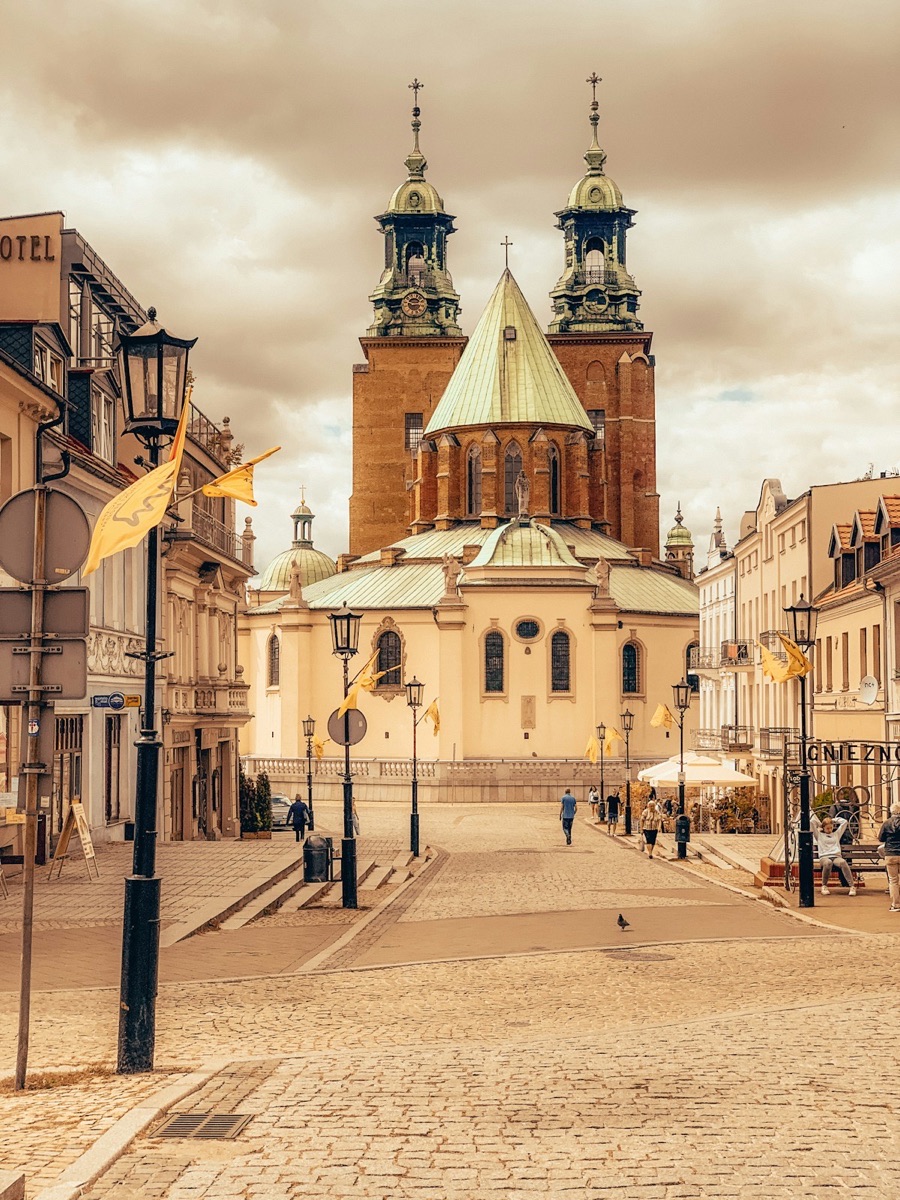
Poznań sits at the heart of the Piast Route - the historical trail through Poland’s cradle of statehood - and several of the country’s most significant early-medieval sites are within easy reach. The choices range from Poland’s first cathedral in Gniezno to a lakeside neo-Gothic castle at Kórnik to a baroque palace surrounded by ancient oak trees at Rogalin. For those less drawn to history, the lakes and forests of Wielkopolski National Park are accessible by bike. All of the following make practical day trips without a car, though having one opens up combinations that public transport cannot match.
Gniezno - Poland’s First Capital
Gniezno was the seat of Poland’s first rulers - the Piast dynasty - and the site of the country’s first cathedral. In 966, Duke Mieszko I accepted Christianity here, a moment considered the founding of the Polish state. The cathedral that stands today is largely 14th-century Gothic, built over earlier Romanesque structures, with a crypt containing the relics of St. Adalbert, Poland’s patron saint.
The Gniezno Cathedral (Archikatedra Gnieźnieńska) is the centrepiece. Entry to the main nave is free; access to the treasury and crypt costs approximately 10 PLN (€2.30) as of 2026. The Gniezno Doors, cast around 1170, are among the finest examples of Romanesque bronze casting in Europe - 18 relief panels depicting the life of St. Adalbert line the southern portal. Allow 45–60 minutes inside.
The old town around the cathedral is compact and walkable: the market square (Rynek) retains its medieval plan, with a 15th-century town hall and several cafes serving lunch. The Museum of the Origins of the Polish State (Muzeum Początków Państwa Polskiego) near the cathedral provides context for the Piast dynasty and the early Church in Poland; entry approximately 15 PLN (€3.50) as of 2026, closed Mondays.
Getting there: Direct PKP trains from Poznań Główny every 30–60 minutes, journey approximately 35–45 minutes, ticket approximately 15–22 PLN (€3.50–5) as of 2026. Timetables at pkp.pl. By car: 55 km east via S5 expressway, approximately 50 minutes.
Allow: Half a day for cathedral and old town only; a full day if combining with Lednica Island (15 km west of Gniezno) or continuing on the Piast Route to Giecz.
Kórnik Castle
Kórnik Castle is among the most picturesque historic buildings in western Poland. The original 14th-century castle was radically remodelled in the early 19th century in the English neo-Gothic style by architect Karl Friedrich Schinkel’s collaborators, producing a crenellated white building reflected in a surrounding moat. The interior houses a museum of the Działyński and Zamoyski noble families who owned the estate: armour, paintings, period furniture, a library of 150,000 volumes, and an armoury with weapons from the 17th to 19th centuries.
The castle is surrounded by an arboretum of approximately 3,000 tree species - one of the largest and most varied collections in Poland. In spring, the rhododendron and azalea section (approximately 1.5 hectares) is particularly well-visited. The arboretum alone is worth the trip in May and June.
Entry: Castle museum approximately 25 PLN (€5.80) for adults, 15 PLN (€3.50) reduced as of 2026; guided tours in Polish available daily. Arboretum entry separate, approximately 12 PLN (€2.80) as of 2026. Combined ticket available.
Getting there: Buses from Poznań Dworzec Autobusowy (PKS or private) run regularly to Kórnik, journey approximately 40–50 minutes, fare approximately 8–12 PLN (€2–3) as of 2026. By car: 23 km south of Poznań via road 434, approximately 30 minutes.
Allow: Half a day for castle and arboretum.
Rogalin Palace and the Ancient Oaks
Rogalin, 24 km south of Poznań, is one of the most unusual estate landscapes in Poland. The late baroque palace (18th century) houses a branch of the National Museum in Poznań with a collection of European and Polish paintings, including works by Jan Matejko and Jacek Malczewski, and a small carriage museum. Entry approximately 20 PLN (€4.60) as of 2026, closed Mondays.
The reason most visitors make the journey, however, is the three ancient oak trees in the park - named Lech, Czech, and Rus after the legendary Slavic brothers said to have founded Poland, Bohemia, and Ruthenia. The largest, Lech, has a circumference of approximately 9 metres and is estimated to be over 700 years old. The surrounding English landscape park contains dozens of further ancient oaks, some among the oldest living trees in Poland.
The park is freely accessible; entry to the palace museum requires a ticket. A small wooden church containing Poznań noble family tombs stands beside the palace.
Getting there: No direct bus from Poznań to Rogalin - a connection via Mosina (accessible by PKP train from Poznań Główny in approximately 25 minutes, then a local bus or taxi) is the most reliable public transport option. By car: 24 km south of Poznań via road 430 through Mosina, approximately 35 minutes. Rogalin is frequently combined with Kórnik (5 km to the east) when visiting by car.
Allow: 2–3 hours for palace and park combined.
Lednica Island - The Piast Cradle
Ostrów Lednicki, a small island in Lake Lednica, is one of the most archaeologically significant sites in Poland. In the late 10th century this island - accessible only by bridge - served as a stronghold and likely the site of the baptism of Mieszko I, Poland’s first ruler, in 966 (though Gniezno also claims this honour). The remains of a 10th-century palatium (palace) and rotunda chapel still stand partially above ground; the island’s museum (open May–October) displays excavated artefacts from the early Piast period, including swords, jewellery, and wooden artefacts preserved in the lake.
Getting there: By car, Lednica is approximately 30 km northeast of Poznań (road 92 towards Gniezno, turn-off at Dziekanowice). The ferry to the island runs from Dziekanowice May–October, approximately 5 PLN (€1.20) each way as of 2026. Museum entry approximately 15 PLN (€3.50) as of 2026. By public transport: PKP train to Gniezno, then a taxi or infrequent local bus to Dziekanowice - logistics are easier with a car or guided tour.
Allow: 2–3 hours including the ferry crossing and museum.
Wielkopolski National Park
For those wanting a nature-focused day out rather than historical sites, Wielkopolski National Park lies immediately southwest of Poznań and can be reached by city bus and train. The park covers 7,600 hectares of glacially shaped lakes, moraines, forest, and river meadows - a flat, gentle landscape well suited to cycling and walking.
Getting there: PKP trains from Poznań to Mosina (25 minutes, approximately 10 PLN/€2.30 as of 2026) drop you on the park’s eastern edge. Line 701 city bus reaches Luboń and the park boundary in approximately 30 minutes. The park has no entry fee; a network of signed hiking and cycling trails covers the main lake circuit (approximately 30 km).
Allow: Half a day to a full day depending on the trail chosen.
Biskupin Archaeological Site
Biskupin is one of the best-preserved Iron Age settlements in Europe, located 90 km northeast of Poznań on a small peninsula in Lake Biskupin. The original settlement dates to around 738 BC - a fortified village of 1,000 to 1,200 people, built on a log platform over the lake with a double oak palisade and 13 rows of longhouses. Most of what stands today is a 1930s reconstruction, but the scale and detail are impressive: you walk streets laid out exactly as excavated, see the gate tower, and enter reconstructed dwellings furnished as they would have been in the early Iron Age.
Getting there: By car, 90 km from Poznań via road 5 northeast toward Żnin - approximately 1 hour 15 minutes. By public transport, take the PKP train to Żnin (approximately 1 hour 30 minutes, change at Inowrocław), then a connecting bus or taxi to Biskupin (10 km). Museum entry approximately 20 PLN (€4.60) as of 2026; open daily May–October, reduced hours in winter.
September Festival: Biskupin hosts an annual Archaeological Festival in mid-September with demonstrations of ancient crafts, archery, and Iron Age reenactment - one of the largest events of its kind in Poland.
Combine with: Gniezno (35 km southwest of Biskupin) pairs well for a full Piast Route day by car - ancient Poland’s origins at Biskupin and its Christian founding at Gniezno.
Allow: 2–3 hours at the site itself.
Planning Your Day Trips
Combining sites: The most efficient combination by car is Rogalin (morning) + Kórnik (midday) - just 5 km apart - leaving Poznań city time in the afternoon. The Piast Route pairing of Gniezno + Lednica Island works well as a historical full-day by car. By public transport, stick to single destinations; Gniezno and Kórnik are the most logistically straightforward.
Guided options: For the Piast Route sites (Gniezno, Lednica, Kórnik), guided day tours from Poznań bundle the transport and context into a single ticket - worthwhile if you want depth without logistics. For greater flexibility across sites, car hire in Poland is the better choice; the road distances are short and roads are straightforward.
Best season: May to September for arboretums and outdoor sites; Gniezno Cathedral is year-round. Rogalin arboretum is best in May (rhododendrons); Lednica Island is May–October only.
Search hotels in Poznań on Booking.com
More in Poznań
- Poznań City Guide - overview, key attractions, and getting there
- Things to Do in Poznań - markets, museums, and the Old Town in depth
- Where to Stay in Poznań - hotels by location and budget
- Best Hotels in Poznań - top-rated options across all price points
- 1 Week in Poland Itinerary - how Poznań and Greater Poland fit a longer route
- 2 Weeks in Poland Itinerary - extended route covering the Piast heartland