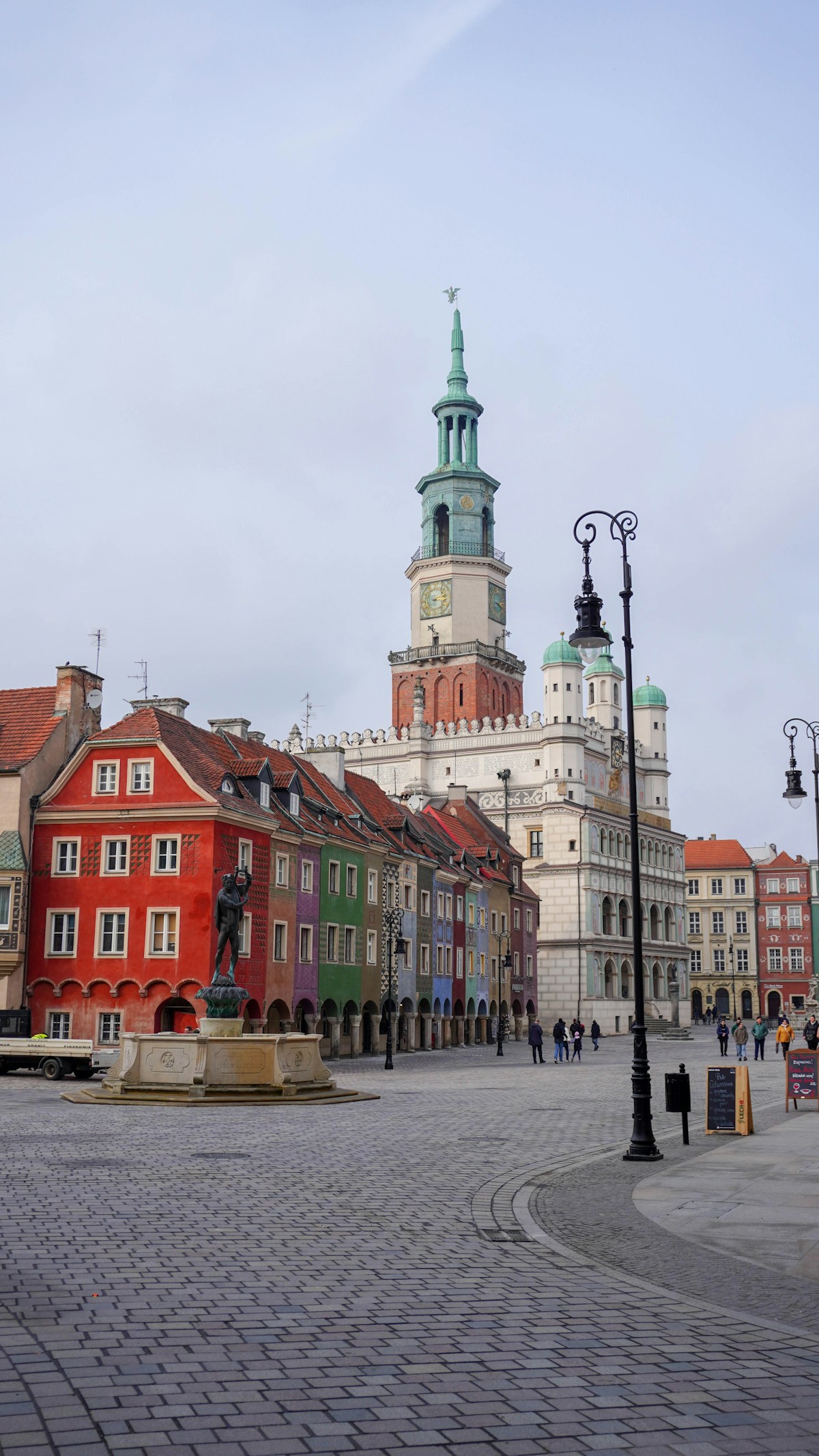
Poznań’s attractions span several distinct layers - the medieval core around the Market Square, the deep historical significance of Cathedral Island, the modern recreation around Malta Lake, and day trips into the Piast dynasty heartland of the surrounding region.
Old Market Square and Town Hall
The Stary Rynek is Poznań’s heart. The Renaissance Town Hall at its centre is the most architecturally distinctive civic building in Poland - designed by Giovanni Battista di Quadro in the 1550s, its three-storey loggia and painted interior rank it among the finest Renaissance structures in Central Europe. The Poznań Historical Museum inside (entry approximately PLN 15 as of 2026) traces the city’s history from its origins to the 20th century. The noon mechanical goats appear at precisely 12:00; arrive five minutes early.
The Merchant Houses (Domki Budnicze) on the south side of the square are a restored row of small arcaded structures from the 17th century, now housing cafés and small shops. The Działyński Palace on the north side is an 18th-century aristocratic townhouse with one of Poznań’s best classical music venues.
Archaeology Museum (Muzeum Archeologiczne) adjacent to the Market Square holds a strong collection from the Piast period and earlier prehistoric settlements, including artefacts from the Lednica island site. Entry approximately PLN 15 as of 2026.
Cathedral Island (Ostrów Tumski)
Poland’s oldest sacred ground, Ostrów Tumski is a short walk east of the Market Square across the Jordan Bridge. The cathedral (free entry to the nave; crypt approximately PLN 5 as of 2026) holds the remains of Mieszko I and Bolesław the Brave in the Golden Chapel - a 19th-century addition of gold mosaics and marble sarcophagi that is impressively lavish. The Archdiocese Museum (entry approximately PLN 10 as of 2026) next door covers religious art from the 10th century onwards.
Śródka - the neighbourhood immediately east of Cathedral Island connected by the Cybina bridge - was a separate village for centuries and retains that character. Several good independent cafés and restaurants have opened here recently; it is less tourist-facing and better value than the Market Square.
Poznań Croissant Museum
The Rogalowe Muzeum Poznania on Stary Rynek offers a practical introduction to the Saint Martin’s croissant - origin story, recipe protection, and live demonstration. Entry approximately PLN 40 as of 2026 and typically includes tasting. Advance booking via the museum website is recommended; groups fill the demonstration slots quickly. Alternatively, simply buying a certified rogal from any bakery displaying the official plaque serves as a direct introduction to the product.
Malta Lake
Jezioro Maltańskie is Poznań’s main outdoor recreation area, 3 km east of the Old Town by tram. The rowing regatta course hosts international competitions; a waterski cable runs on the lake; rowing boats and canoes are rentable from approximately PLN 25 per hour as of 2026. The Termy Maltańskie thermal baths complex (entry approximately PLN 45 for a 3-hour session as of 2026) is open year-round and popular in winter.
The Poznań Zoo is adjacent to Malta Lake (entry approximately PLN 40 adults as of 2026) and focuses on animals from five continents in enclosures that were significantly modernised after 2010.
Day Trips
For a structured introduction to Poznań’s history, guided tours of Poznań cover the Old Town and Cathedral Island with expert local commentary.
Gniezno: 50 km east by train (approximately 40 minutes, from approximately PLN 20 as of 2026). Poland’s first capital and archbishopric. The cathedral contains the Gniezno Doors - 12th-century bronze doors depicting the life of Saint Adalbert - which are among the greatest pieces of Romanesque art in Europe.
Lednica: 30 km east. The island fortress-palace site on Lake Lednica where the Piast dynasty established early rule. A skansen (open-air museum) on the lakeshore accompanies the island site. Entry approximately PLN 20 as of 2026; seasonal ferry to the island from May–October.
Kórnik Castle: 22 km south-east. A 19th-century neo-Gothic castle in English Romantic style set in an arboretum. Entry approximately PLN 25 as of 2026. Accessible by bus from Poznań in approximately 35 minutes. For castle and UNESCO site visits in the region, booking tickets in advance avoids queues at popular sites during peak season.
Search hotels in Poznań on Booking.com
More in Poznań
- Poznań City Guide - overview, restaurants, hotels, and getting there
- Where to Stay in Poznań - hotels and hostels by area and budget
- Poznań vs Łódź - comparing two of Poland’s most underrated cities
- Getting Around Poland - trains from Warsaw and Wrocław to Poznań
- Łódź City Guide - the creative arts city 180 km south-east, easily paired with Poznań
- 10 Days in Poland Itinerary - how Poznań fits a western Poland route
- Poland Budget Guide - what things cost in Poznań vs Warsaw and Kraków
- Cycling in Poland - the Warta River cycling route through Poznań and surroundings