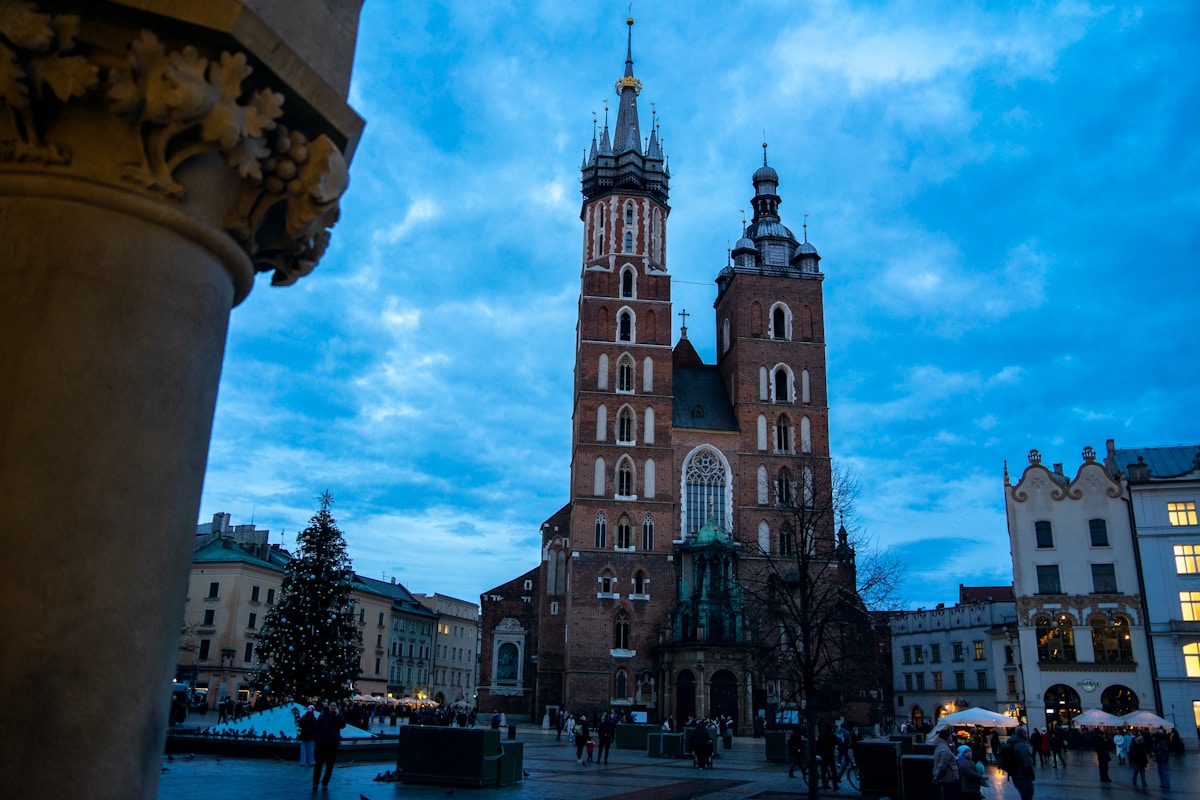
Winter in Poland runs from December through February and divides neatly into two phases: the festive period from late November through the first week of January, when Christmas markets, decorated cities, and holiday spirit make the country genuinely magical; and the quieter stretch of January and February, when crowds disappear entirely, prices drop sharply, and you have Poland’s major museums and historic streets almost to yourself. Guided winter tours in Poland cover Christmas market walks, WWII history circuits, and snow-season day trips from Kraków and Warsaw.
Neither phase is a compromise. Both are worth choosing deliberately.
Weather Across the Country
Poland sits in central Europe and experiences a continental climate - colder winters than Western Europe, occasional extremes in January and February, and variable cloud cover throughout.
| City | December Avg | January Avg | February Avg |
|---|---|---|---|
| Warsaw | -1°C to 3°C | -4°C to 1°C | -3°C to 2°C |
| Kraków | -1°C to 4°C | -4°C to 1°C | -3°C to 3°C |
| Wrocław | 0°C to 5°C | -3°C to 2°C | -2°C to 4°C |
| Gdańsk | 0°C to 4°C | -3°C to 2°C | -2°C to 3°C |
| Zakopane | -5°C to 0°C | -8°C to -3°C | -7°C to -1°C |
Frost is common in all cities. Heavy snowfall in Warsaw is less frequent than popular imagination suggests - the city averages around 30 days per year with snow cover, concentrated in January and February, but it is not reliably snow-covered for weeks at a time. Kraków is slightly snowier. Zakopane in the Tatra Mountains is reliably snow-covered from mid-December through March.
Christmas Markets: The Real Reason to Go in December
Poland’s Christmas markets (jarmarki świąteczne) are among the best in Europe and significantly less crowded than the famous markets in Vienna, Nuremberg, or Strasbourg. They typically run from late November through December 26, sometimes extending to early January.
Kraków - Main Market Square (Rynek Główny)
Kraków’s market is Poland’s largest and best-attended. The setting - a 13km² medieval market square, the largest in medieval Europe, ringed by Gothic and Renaissance architecture - is impossible to fault. Around 100 stalls sell regional handicrafts, oscypek (smoked sheep’s cheese from the Tatras, approximately 15–25 PLN / €3.50–6 per piece), mulled wine (grzaniec) at 12–18 PLN (€2.80–4.20), and obwarzanki (the distinctive Kraków ring bread, 3–5 PLN / €0.70–1.20).
The Szopka competition - uniquely Kraków, UNESCO-recognised since 2018 - displays elaborate hand-built nativity scenes (szopki) that can be several metres tall and incorporate Kraków’s architectural landmarks into their designs. The finest examples are exhibited at the Kraków City Museum at Krzysztofory Palace, Rynek Główny 35 (entry approximately 20 PLN / €4.70).
Market open daily approximately 10:00–21:00 from late November through December 26.
Wrocław - Market Square (Rynek)
Wrocław’s market is widely considered the most atmospheric in Poland, partly because the Market Square itself - a 213m x 178m space surrounded by coloured Gothic and Baroque townhouses - functions as a natural amphitheatre for the market. The stalls occupy the central square with the medieval city hall as a backdrop.
Wrocław’s market is slightly smaller than Kraków’s but better curated - fewer cheap imported goods, more emphasis on local Silesian crafts, amber jewellery, and regional food. Look for żurek in bread bowls (15–22 PLN / €3.50–5) and locally made gingerbread. The city’s tradition of gnome (krasnal) figurines continues at Christmas with limited-edition seasonal gnomes sold at dedicated stalls, 20–45 PLN (€4.70–10.50).
Market open daily approximately 10:00–22:00 from late November through January 1.
Warsaw - multiple locations
Warsaw splits its Christmas market across several locations. The main market runs at Castle Square (Plac Zamkowy) in the Old Town - around 60 stalls, traditional crafts, and food. A separate, trendier market operates at Nowy Świat street in the city centre, leaning toward artisanal produce and design goods. A third market at Praga Koneser (the former vodka factory complex, now a cultural centre) is the most local-feeling of the three, attracting Warsaw residents more than tourists.
Warsaw’s Christmas lights along Nowy Świat and Al. Jerozolimskie are among the most elaborate in Poland - worth seeing after dark even if you’re not shopping.
Gdańsk - Long Market (Długi Targ)
Gdańsk’s market occupies the famous Long Market in the historic city centre, framed by the Golden Gate, the Main Town Hall, and the Green Gate - a particularly dramatic backdrop. The market has a strong amber focus (Gdańsk is the amber capital of Poland) and dedicated stalls for high-quality pieces start around 80–200 PLN (€19–47). Verify amber quality before buying - ask sellers for documentation of natural amber.
Beyond the Markets: What Else to Do in Polish Winter
Museum Season
Winter is peak season for Poland’s indoor attractions. Queues at Auschwitz-Birkenau Memorial (advance booking required year-round but wait times are minimal in January–February), the Warsaw Rising Museum, and Kraków’s Wawel Royal Castle shrink dramatically after the Christmas market period ends.
Warsaw Rising Museum - Jana Pawła II 23, Warsaw. One of the most important WWII museums in Europe. Allow 3–4 hours minimum. Entry 30 PLN (€7) standard; free on Sundays. Open Tuesday–Sunday 10:00–18:00 (Thursday until 20:00). Book tickets online to avoid any queue.
Wawel Royal Castle - Wawel Hill, Kraków. Entry to the state rooms and Royal Private Apartments runs 35–85 PLN (€8–20) depending on route selected. The castle grounds are free to walk. Open Tuesday–Sunday 9:00–17:00 in winter; closed Monday.
National Museum in Warsaw - Aleje Jerozolimskie 3. Strong collection of Polish art, ancient Egyptian artefacts, and European masters. Entry 25 PLN (€6); free on Tuesdays. Open Tuesday–Sunday 10:00–18:00.
Skiing and Mountain Resorts
Zakopane in the Tatra Mountains is two hours south of Kraków by bus (from 20 PLN / €4.70 one way on FlixBus or Polski Bus) and is Poland’s ski capital. The ski season runs approximately mid-December through March depending on snowfall.
The main ski areas - Kasprowy Wierch and Gubałówka - are small by Alpine standards but offer excellent value. Day ski passes run approximately 130–180 PLN (€30–42) as of 2026. The gondola to Kasprowy Wierch (Poland’s highest cable car, reaching 1,985m) operates weather-dependent and tickets sell out in advance during the Christmas and February school holiday periods - book online.
Thermal Baths
For a rest-day option in southern Poland, Termy Szaflary (25km south of Zakopane) has extensive outdoor thermal pools open year-round. Soaking in 36°C water while snow falls around you is genuinely pleasurable. Entry approximately 80–120 PLN (€19–28) for a half-day session depending on pool access.
What to Pack
Winter in Poland requires actual preparation - the city walking distances are significant and being cold and wet for an entire day ruins the experience.
Footwear: Insulated, waterproof boots with a non-slip sole. Pavements freeze and are not always gritted quickly. Regular trainers or fashion boots are a mistake.
Outer layer: A waterproof, wind-resistant jacket rated to at least -10°C. Wool or down works well in dry cold; down loses insulation when wet, so a synthetic inner or waterproof shell matters.
Layers: Thermal base layer (merino or synthetic) under a mid-layer fleece or down jacket. Wearing three lighter layers stays warmer and more adaptable than one heavy coat.
Accessories: Hat covering the ears, warm gloves (not fashion gloves), a scarf that can cover the lower face. Temperatures below -5°C with wind feel significantly colder.
Practical: A portable charger - phone batteries drain faster in cold weather. A small backpack so you can carry extra layers when indoors.
Why Winter Works for Poland
Accommodation prices drop 20–40% compared to July and August at the same properties in Warsaw, Kraków, and Wrocław. Major attractions are accessible without long queues from mid-January onward. Christmas markets from late November through December 26 provide genuine festive atmosphere. The cities are cleaned up for the holiday season and illuminated well into January.
The clearest advantage is scale - Kraków’s Old Town in early February, with its Gothic architecture and almost no crowds, is a fundamentally different and more peaceful experience than the same streets in August when tour groups make normal walking difficult.
The one genuine limitation is daylight: Poland in January sees sunrise at 7:45 and sunset at 15:45 in Warsaw, giving approximately 8 hours of daylight. Plan outdoor sightseeing in the morning and early afternoon, and treat the long evenings as time for restaurants, museums, and bars - which is not a hardship.
Plan Your Trip
✈️ Book your flights to Poland 🛡️ Get travel insurance 📱 Stay connected with an eSIM 🚗 Rent a car