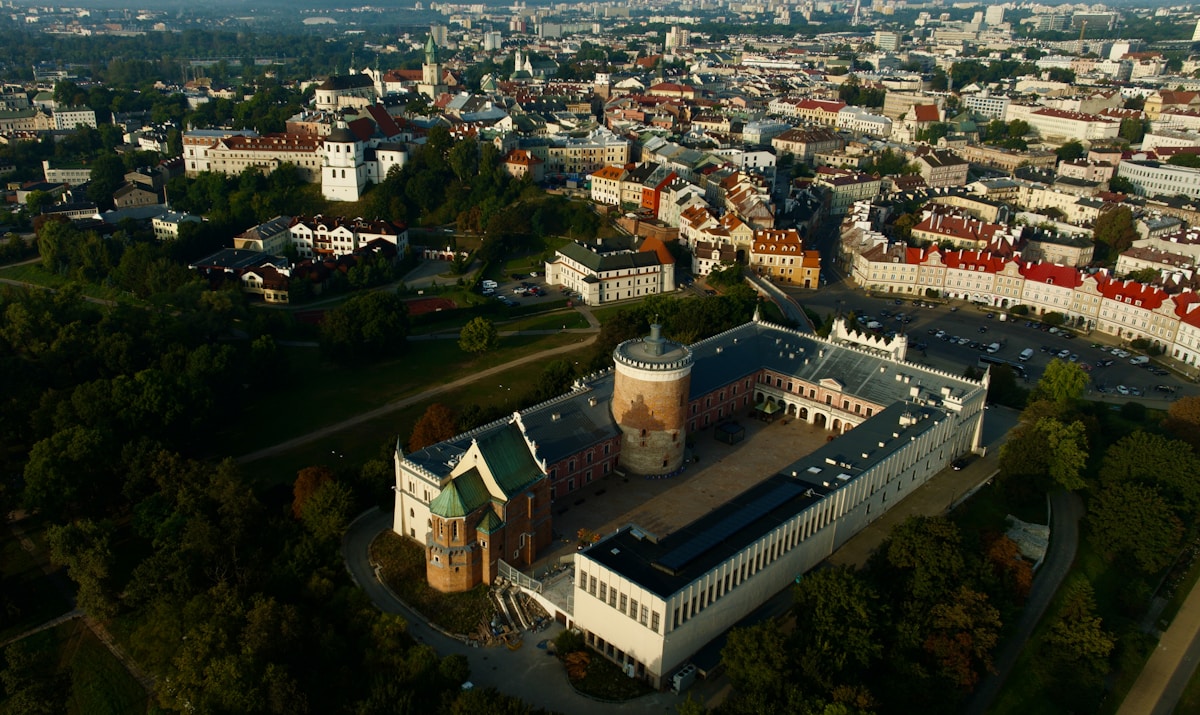
Eastern Poland is one of the most overlooked travel regions in the country - visitors come for Warsaw, Kraków, Gdańsk, and Wrocław, and rarely push further east. Lublin and Zamość are the two most compelling reasons to do so. They are very different cities - Lublin is a functioning university city of 340,000 people; Zamość is a small Renaissance planned town of 65,000 - but both hold a density of history and architecture that is surprising given how little they appear in most Poland travel plans.
Overview
Lublin is the largest city in eastern Poland east of Warsaw, with around 340,000 residents and a major university (Maria Curie-Skłodowska University, with over 20,000 students). The Old Town is compact and well-preserved, centred on the Cathedral and the Lublin Castle above the valley. The city has a layered history - it was one of the most important Jewish cities in Poland (at its peak, around a third of Lublin’s population was Jewish) and the site of the Majdanek concentration camp on its outskirts, one of the largest and most intact surviving Nazi camps. Lublin also has a thriving contemporary cultural scene, with independent galleries, a strong festival calendar, and a coffee and bar scene disproportionately active for a city of its size. For what to do, see our Lublin things to do guide.
Zamość is a planned Renaissance city founded in 1580 by the nobleman Jan Zamoyski and designed by the Italian architect Bernardo Morando. The entire Old Town was laid out on a Renaissance ideal city plan - a grid of wide streets converging on a central market square, surrounded by fortifications - and has survived largely intact. It is a UNESCO World Heritage Site. The population is around 65,000. There are no large museums, no concentration of famous attractions - just a very well-preserved Renaissance urban environment that is genuinely unlike anywhere else in Poland, and one of the most unusual and complete examples of Renaissance town planning in Central Europe. For detailed recommendations, see our Zamość things to do guide.
Getting Between the Cities
Lublin and Zamość are approximately 90 km apart. Direct buses connect the two cities in approximately 1.5–2 hours; fares approximately PLN 20–30 as of 2026. There is no direct train - rail requires a change and is slower than the bus. By car it is approximately 1.5 hours via the S17 and S12.
The distance is short enough that Zamość can be visited as a day trip from Lublin, though an overnight stay in Zamość is strongly recommended for the experience of the Old Town after the day visitors depart.
Things to Do
Lublin has a rich and somewhat sobering set of attractions. The Lublin Castle on the hill above the Old Town is the architectural centrepiece - currently partly under renovation - with the Holy Trinity Chapel inside containing 15th-century Byzantine-Ruthenian frescoes of exceptional quality (approximately PLN 15 entry for the chapel as of 2026). The Majdanek State Museum on the southeastern edge of the city is one of the most significant and affecting Holocaust memorial sites in Europe - unusually intact, with the original barracks, gas chambers, and crematoria still in place. Entry is free. The gravel Lublin Old Town streets running between the 14th-century Kraków Gate and the castle hill are best explored on foot. The Grodzka Gate - Grodzka Gate–NN Theatre (Brama Grodzka) is a cultural institution occupying the historic gate that once divided the Polish Christian and Jewish quarters of the city; the permanent exhibition on Lublin’s Jewish heritage is moving and well-produced.
Zamość is essentially one attraction: itself. The Great Market Square (Rynek Wielki), surrounded by Renaissance arcaded townhouses, is one of the finest planned urban spaces in Poland. The Town Hall in the centre of the square dates from the late 16th century and is free to appreciate from outside. The Cathedral of the Resurrection of Christ and St Thomas the Apostle on the adjacent square was built in 1600 and contains several notable artworks. The Bastion fortifications around the Old Town can be walked in around 45 minutes. The Zamość Regional Museum (entry approximately PLN 12 as of 2026) gives context to the city’s founding and its Renaissance plan. Beyond the planned architecture, the main activity is walking, eating, and sitting in one of the café terraces in the arcaded squares.
Edge: Lublin for cultural and historical depth; Zamość for architectural uniqueness and UNESCO heritage.
Food and Drink
Lublin has a well-developed food scene sustained by its large student population. The Old Town and the streets around the Kraków Gate have the highest concentration of restaurants and bars. Regional cuisine in this part of Poland is hearty and influenced by Ukrainian and Jewish culinary traditions - stuffed cabbages, buckwheat, herring, and various baked pastries feature alongside standard Polish dishes. Mid-range dinners run approximately PLN 40–80 per person as of 2026. The coffee and café scene is notably active; several independent roasters have opened in recent years. See our Lublin where to stay guide for neighbourhood orientation.
Zamość has a smaller but good enough food scene for a short visit. The best restaurants and cafés cluster around the Great Market Square and the arcaded townhouses - eating in a Renaissance loggia is an atmosphere no other Polish city offers in quite this way. Prices are generally lower than Lublin; mid-range dinner approximately PLN 35–65 per person as of 2026. For a small city the quality is solid, if limited in variety. See our Zamość where to stay guide.
Edge: Lublin on range and café culture; Zamość on atmosphere.
Where to Stay
Lublin offers a full range of accommodation options appropriate to a city of its size. Hotel Mercure Lublin Centrum is the most reliable mid-range international option (from approximately PLN 320–450 per night as of 2026). Grand Hotel Lublinianka on the main street Krakowskie Przedmieście is the historic option, recently renovated (from approximately PLN 380–500 per night). Budget hostels operate in the Old Town; dorms from approximately PLN 70–100 per night. See our Lublin where to stay guide.
Zamość is a small city with limited but adequate accommodation. Hotel Orbis Zamojski, occupying a period building just off the Great Market Square, is the most established mid-range option (from approximately PLN 280–380 per night as of 2026). For the most atmospheric option, several Renaissance townhouses in the Old Town have been converted to small guesthouses and apartments (from approximately PLN 200–350 per night). Staying within or immediately adjacent to the Great Market Square is strongly recommended - the experience of the town after tourists depart in the early evening is one of the best arguments for an overnight stop. See our Zamość where to stay guide.
Edge: Lublin on range and budget options; Zamość on architectural atmosphere.
Search hotels in Lublin on Booking.com
Nightlife
Lublin has an active bar scene concentrated in the Old Town and around the university area. The young population sustains a year-round calendar of live music, club nights, and gallery events. Several bars occupy old cellars along the Old Town streets. The Lublin Festival calendar includes Carnaval Sztukmistrzów (street theatre, late July) and various music events.
Zamość has limited nightlife - a few bars around the Market Square and a small club or two. In summer there are occasional outdoor concerts on the square. The city is not a nightlife destination; most visitors arrive by day and leave by evening.
Edge: Lublin decisively.
Budget
| Expense | Lublin | Zamość |
|---|---|---|
| Hostel dorm (per night) | PLN 70–100 | PLN 65–90 |
| Mid-range hotel (per night) | PLN 280–450 | PLN 220–380 |
| Lunch (budget / café) | PLN 20–35 | PLN 18–30 |
| Restaurant dinner (mid-range) | PLN 40–80 | PLN 35–65 |
| Museum entry (average) | PLN 10–20 | PLN 8–15 |
| Bus between cities | - | PLN 20–30 |
All approximate, as of 2026. Zamość is noticeably cheaper across all categories, reflecting its size and lower tourist infrastructure.
The Verdict
Choose Lublin as your base if: you want a fully functional city with a wide range of accommodation, food, nightlife, and a base for exploring eastern Poland more broadly - including Majdanek, the Roztocze landscape park, and the Chełm area.
Choose Zamość as your base if: you want a singular, deeply atmospheric Renaissance town that offers something genuinely rare in Central Europe - a planned city that has survived nearly intact and is small enough to explore fully in two days.
The strongest recommendation is to combine both. Base in Lublin for two or three nights, take the bus to Zamość and spend one or two nights there, then return to Lublin or head onward. The combination - a living university city alongside a frozen-in-time Renaissance gem - is one of the most rewarding itineraries in Poland. Guided tours from Warsaw or Kraków that include eastern Poland often pair these two cities together, which is a practical option if you prefer not to self-navigate the bus connections. See our full guides to Lublin and Zamość for detailed planning.
Plan Your Eastern Poland Trip
- Things to Do in Lublin - Majdanek, the Byzantine castle chapel, and the Old Town
- Things to Do in Zamość - the Renaissance old town, fortifications, and market
- Bieszczady Hiking Guide - the wild mountains further southeast, accessible from this region
- 2 Weeks in Poland Itinerary - how eastern Poland fits a longer Polish trip
- Getting Around Poland - bus and train connections across eastern Poland
More Poland Comparisons
- Poznań vs Łódź - two underrated western cities compared on culture, food, and cost
- Zakopane vs Jelenia Góra - Poland’s two mountain town options head to head
- Poland vs Czech Republic - if eastern Poland has you wondering whether Prague belongs on the itinerary