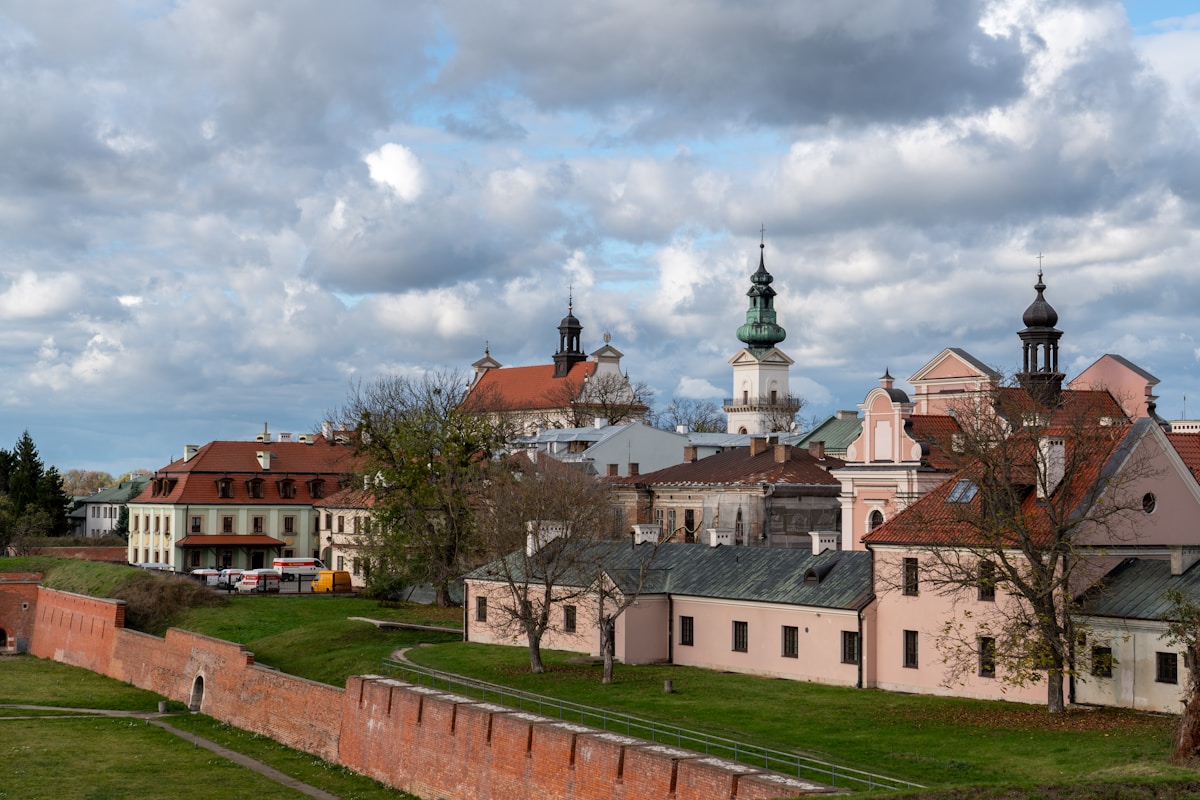
Zamość is one of the most remarkable urban experiences in Poland precisely because it is not on the standard tourist circuit. The city was designed as a complete Renaissance ideal in the 1580s - market square, palace, cathedral, fortifications, and residential streets - and executed with exceptional architectural coherence over the following decades. Walking the Old Town today is to experience that original design largely intact, a quality that the UNESCO designation recognised in 1992.
Great Market Square (Rynek Wielki)
The Great Market Square is the obvious starting point and never loses its capacity to impress. It is a large, rectangular Renaissance plaza - approximately 100 by 100 metres - with the Town Hall at its centre and arcaded townhouses on three sides. The facades are painted in ochres, terracottas, and greens and draw on Italian models while remaining distinctly Polish in their decoration. The arcades at ground level shelter cafes and shops and were originally used by Zamość’s merchant community - the city was founded partly as a trading hub on the route between Western Europe and the Ottoman Empire.
Town Hall (Ratusz): The tall, narrow Town Hall tower (64 metres) dominates the square and is the most recognisable structure in the city. The elaborate external staircase with double-flight steps is one of the most photographed scenes in Zamość. The tower is open to visitors (approximately PLN 10 as of 2026) with views over the Old Town’s rooflines and the surrounding flatlands. The interior houses the Regional Museum (separate ticket approximately PLN 15) covering Zamość’s history from its founding through the 20th century.
The Armenian Quarter
The Armenian Quarter (Ormiańska) to the northeast of the market square is one of the most distinctive parts of the Old Town. When the city was founded in 1580, Jan Zamoyski invited Armenian merchants to settle here as part of a policy of attracting skilled traders from across Europe and the Near East. The Armenian merchant houses on ul. Ormiańska retain their original facades and are unusually well-preserved. The Armenian House Museum (Dom Ormiański) at no. 22–30 covers the community’s history and the trade routes that brought them here. Entry approximately PLN 8 as of 2026.
Zamość Cathedral (Katedra Zmartwychwstania Pańskiego)
The Cathedral, also designed by Bernardo Morando, stands at the northeast corner of the market square and is the most significant church in the city. Construction began in 1587 and the building went through several phases of modification over the following centuries without losing its Renaissance core character. The interior has good Mannerist altarpieces, an ornate 17th-century font, and the tomb of Jan Zamoyski and later members of the Zamoyski family in the crypt. Entry free; crypt approximately PLN 5 as of 2026.
The Fortifications
The star-shaped fortification system that Morando designed around the city is one of the finest surviving examples of Italian Renaissance military engineering in Central Europe. Walk the outer circuit of the walls to see the Lublin Gate (Brama Lubelska), the Lwów Gate (Brama Lwowska), and the four surviving bastions - all in remarkably good condition given their 430-year age.
The Zamoyski Palace (Pałac Zamoyskich) at the western end of the Old Town is the former residence of the Zamoyski family, now used by the local court, and is not open for public tours but its exterior and the adjoining gardens are accessible. The Zamoyski Academy ruins (visible on ul. Akademicka) are remains of a university founded here in 1594 that operated until 1784.
The Synagogue
Zamość had a substantial Jewish community from the city’s earliest years - the Old Synagogue (Stara Synagoga) on ul. Pereca dates from the 17th century and survived the Second World War relatively intact. The interior has been restored and now functions as a cultural centre with exhibitions on the Jewish history of the region. Entry approximately PLN 5 as of 2026. The Jewish heritage trail around the city takes approximately 2 hours and is described in a free leaflet available from the tourist office.
Zamość Arsenal and Fortification Museum
The restored Arsenal building near the Lublin Gate houses a military museum covering Zamość’s role in the various wars and sieges it has endured - the city was besieged during the Swedish wars of the 17th century, the partitions, and the Second World War. Entry approximately PLN 12 as of 2026. The collections are strongest on the 17th–19th century period with some good original weapons, armour, and maps.
Getting There and Day Trip Planning
From Lublin: PKS buses run from Lublin bus station to Zamość approximately every 30–60 minutes, journey approximately 1.5 hours, tickets approximately PLN 25 as of 2026. Return services run through the evening, making a day trip feasible. Guided tours of eastern Poland that include Zamość alongside Lublin are a practical option for visitors who want contextual history alongside the architecture.
From Warsaw: Direct PKS buses from Warsaw Młociny terminal take approximately 4–4.5 hours; more comfortable is to go via Lublin (train to Lublin then bus). A same-day return from Warsaw is possible but long; an overnight stay is strongly recommended.
Within Zamość: The entire Old Town is walkable in all directions from the market square. Flat terrain and compact distances make Zamość exceptionally easy to navigate on foot.
Search hotels in Zamość on Booking.com
More in Zamość
- Zamość City Guide - overview, hotels, restaurants, and getting there
- Lublin City Guide - nearest major city, 1.5 hours by bus
- Lublin vs Zamość - how to choose between the two eastern cities
- Getting Around Poland - buses and transport for eastern Poland
- Things to Do in Lublin - Majdanek memorial, castle, and Old Town in the regional capital
- Bieszczady Hiking Guide - the wild mountains accessible from this part of Poland
- 2 Weeks in Poland Itinerary - how eastern Poland fits a longer visit