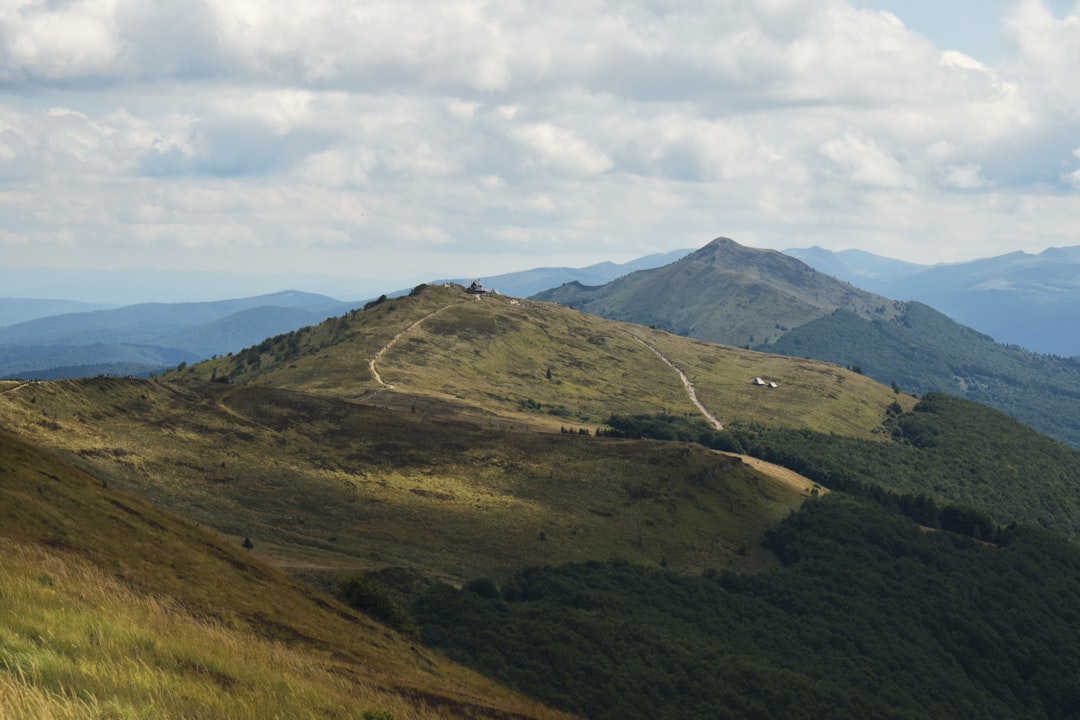
The Bieszczady Mountains occupy the far southeastern corner of Poland, where the borders of Poland, Slovakia, and Ukraine converge. They are the least visited, least developed, and most genuinely wild mountain range in the country.
Where the Tatras are spectacular and busy, the Bieszczady are quiet and remote. The landscape is defined by the Połoniny - wide, open alpine meadow ridges that roll along the skyline without the sharp rocky drama of the Tatras, but with a spaciousness and sense of wilderness that draws a loyal following. Wolves, lynx, European bison, and brown bears all live here. Mobile signal is intermittent. Infrastructure is thin.
That is precisely why people come.
Bieszczady National Park
Entry fee: approximately PLN 7 per day as of 2026, payable at staffed kiosks near the main trailheads at Wołosate and Ustrzyki Górne. The fee supports conservation of one of the best-preserved large mammal ecosystems in central Europe.
The park covers approximately 292 square kilometres and forms part of the International Biosphere Reserve UNESCO designated in 1992 across the Polish, Slovak, and Ukrainian portions of the range. There are no cable cars, no major resort towns within the park boundaries, and no fast food. Bring everything you need.
Trail marking: Standard PTTK colour-coded trails apply. The main ridge trail is marked red; valley approaches are marked yellow, blue, or green.
Key Trails
Tarnica (1,346m - Highest Peak in Polish Bieszczady)
Tarnica is the highest summit in the Polish Bieszczady and the standard objective for a first visit. The trail departs from Wołosate, the last village before the Ukrainian border, and gains approximately 540 metres of elevation over roughly 3.5 kilometres to the summit.
Difficulty: Moderate. Wide, well-marked trail through forest and then open Połonina meadow. No technical terrain. The summit ridge is exposed and can be windy.
Duration: 4–5 hours return from Wołosate, including reasonable time at the summit. Allow longer if continuing along the ridge.
What to expect at the summit: The view stretches across the Połoniny east into Ukraine and south into Slovakia. You may be the only group on the summit even in peak season. This is a mountain range where solitude is still available.
Getting to Wołosate: By car from Ustrzyki Górne (the nearest village with accommodation), approximately 8km. No public transport serves Wołosate - you either drive or join a guided group with transport.
The Połoniny Ridge: Wielka Rawka and Rozsypaniec
The main red-marked ridge trail runs westward from Tarnica through a sequence of open summits. Wielka Rawka (1,304m) and Rozsypaniec (1,280m) are the two most commonly walked ridge sections, with the trail traversing wide, grassy tops with unobstructed views.
Difficulty: Easy to moderate on the main ridge. The exposed ridgeline requires caution in poor weather - afternoon thunderstorms are possible in summer and the open terrain offers no shelter.
A full ridge walk from Tarnica to the western end of the Połoniny takes 2–3 days with overnight stays at mountain huts (schroniska). This multi-day traverse is one of the finest long-distance walks in Poland for those willing to plan logistics carefully.
Wetlina Połonina (Połonina Wetlińska)
Accessed from the village of Wetlina, this section of the Połoniny is slightly more accessible than the Tarnica–Rawka area and a good alternative for day hikers based in Ustrzyki Dolne or arriving by public transport to Lesko. The mountain hut at Połonina Wetlińska offers accommodation and meals - book in advance at bieszczady.pl or directly with the hut.
Guided Operators
Bieszczady Active (Rzeszów-based) The most established guided hiking operator in the Bieszczady region. Full-day hikes including transport from Rzeszów or Lesko cost approximately PLN 200–350 per person as of 2026. Trips include Tarnica, the main Połoniny sections, and multi-day itineraries. English-speaking guides available on request. Book via bieszczadyactive.pl. You can also browse guided nature and hiking tours in Poland for operators covering the Bieszczady and other eastern Poland destinations.
Local guides registered with Podkarpacie Tourist Organisation A smaller network of licensed guides based in Ustrzyki Dolne and Lesko offer bespoke day hikes and multi-day routes through the park for approximately PLN 250–400 per guide per day as of 2026 (group fee, not per person). Contact through the Lesko tourist information office or via podkarpackie.pl/turystyka.
For independent hikers, the park is navigable with a good 1:50,000 or 1:25,000 map (available at bookshops in Lesko and Sanok). GPS tracks are available via Mapa Turystyczna (polska.e-mapa.net).
Wildlife and Environment
The Bieszczady National Park has some of the highest concentrations of large predators and megafauna in Poland. Wolves (Canis lupus) are resident throughout the park and cross the open Połoniny regularly. Lynx (Lynx lynx) are present but very rarely seen. Brown bears (Ursus arctos) inhabit the denser forest sections - their number is estimated at 80–100 individuals in the broader Bieszczady ecosystem.
European bison (Żubr, wisent) were reintroduced to the Bieszczady in the 1960s after extinction in the wild. A herd of approximately 500–600 individuals now ranges through the park and the wider buffer zone. Bison sightings are possible, particularly in early morning and evening near the forest edges at Lesko and Ustrzyki Dolne.
Do not approach any wildlife. If you see a bear, remain calm, speak in a low voice, and back away slowly.
Best Season
June–September is the main trekking season. July and August offer the warmest conditions but also bring afternoon convective storms - start early.
September is arguably the best month. The crowds that do exist have thinned, the Połoniny meadows take on golden and amber colours, and clear autumn days can offer the longest visibility. Wildlife activity is also high as animals begin pre-winter feeding cycles.
October: Trails passable but conditions become unpredictable. Snow can arrive from late October on the higher sections.
Getting There and Base Camps
By car from Rzeszów: Approximately 100–110km southeast, 2–2.5 hours via Sanok. This is the most practical approach. Rzeszów is served by train from Warsaw Centralna (~2.5 hours, approximately PLN 60–100 as of 2026) and from Kraków (~2 hours, approximately PLN 40–80 as of 2026).
By bus from Rzeszów: PKS and private bus services run to Lesko, Ustrzyki Dolne, and in limited frequency to Ustrzyki Górne. Journey Rzeszów–Ustrzyki Górne approximately 2.5–3 hours. Services are infrequent - check the current timetable at e-podroznik.pl before planning.
No direct train service reaches the national park area. Sanok (further from the park) has limited rail connections. For most independent visitors, a car is effectively necessary for accessing the main trailheads - hire a car in Poland from Rzeszów or Kraków before heading south.
Base: Ustrzyki Górne is the closest village to the main Tarnica trailhead, with a handful of guesthouses and the nearest mountain hut. Very limited facilities.
Base: Lesko is a small town 40km north of the park with a wider range of accommodation, restaurants, a supermarket, and a bus connection to Rzeszów. Suitable for those who want a more comfortable base and plan to drive into the park each day.
Search hotels in Poland on Booking.com
Practical Details
Self-sufficient hiking: The Bieszczady is not the Tatras. Facilities in the park are minimal. Carry all food and water for the day. There are mountain huts at key points on the longer ridge routes, but they are not reliable for spontaneous use - reserve in advance at bieszczady.pl.
Mobile signal: Intermittent or absent in much of the park. Download offline maps before departure.
Emergency: Mountain rescue in the Bieszczady is handled by GOPR Bieszczady (Group of Mountain Volunteer Rescuers). Call 985 or 112. Response times in this remote area can be longer than in the Tatras.
Gear: Waterproof jacket, reliable footwear, and sufficient water are the minimum. For multi-day ridge walks, full camping equipment or advance hut reservations are essential.
Related City Guides
- Rzeszów City Guide - the nearest large city and practical base for the Bieszczady
- Kraków City Guide - the most common starting point for travellers heading southeast
- Tatra Mountains Trekking - Poland’s other great hiking area in the south
- Best Time to Visit Poland - seasonal guide for trekking conditions
Plan Your Bieszczady Trip
- Zamość City Guide - a UNESCO Renaissance city in eastern Poland, 2 hours north of the Bieszczady - worth combining on a longer eastern Poland route
- Lublin City Guide - eastern Poland’s cultural capital, a natural stop before or after the Bieszczady
- Tatra Mountains Trekking - Poland’s highest peaks and most popular alpine terrain, a counterpoint to the Bieszczady’s wild remoteness
- Visiting Poland in September - September is the optimal month for Bieszczady hiking: stable weather and the autumn colour season
- Getting Around Poland - car hire is effectively necessary for accessing the Bieszczady; this guide covers your options
- Kayaking the Masurian Lakes - Poland’s other outstanding wilderness region for active travellers, in the northeast