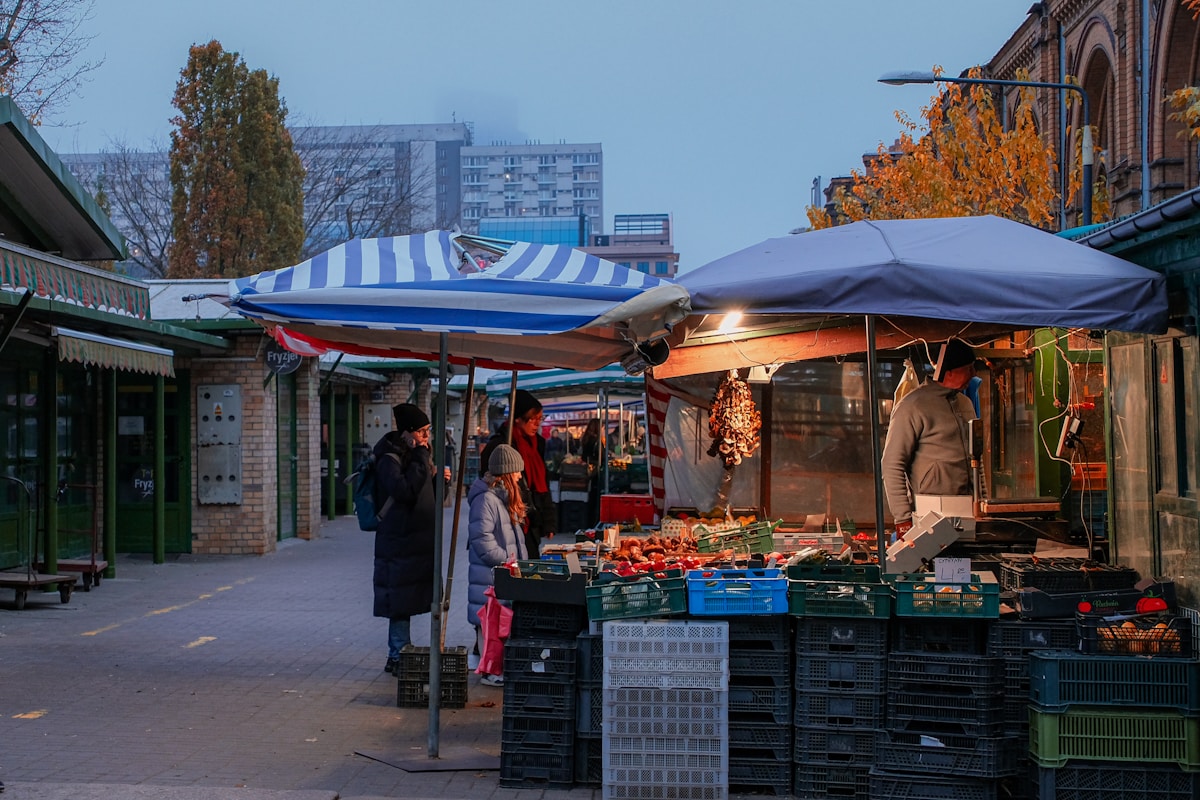
Warsaw’s food scene carries more weight than most visitors expect. The city was almost entirely destroyed in the Second World War - over 85 percent of the built fabric was levelled - and rebuilt largely during the communist period. That history shaped what Warsaw eats in ways that are still visible today: the milk bar tradition, the zapiekanka culture, the dense web of local markets that survived as food distribution points throughout the postwar decades.
What has emerged since 1989 is a city with strong culinary roots and a modern restaurant scene growing on top of them. The Old Town, Nowy Świat, and the Praga district on the east bank of the Vistula each have distinct food characters. Combine them into a single day and you cover the full range - communist-era nostalgia, 19th-century patisserie traditions, covered market cooking, and contemporary Polish cuisine drawing on the same ingredients.
This guide covers a self-guided food walk through Warsaw, the key dishes to look for, where to do a vodka tasting, and what to expect from guided food tours in the city.
The Warsaw Food Walk: 5 Stops
Stop 1: Pączki at A. Blikle, Nowy Świat
Start on ulica Nowy Świat, Warsaw’s most elegant commercial street, at A. Blikle (Nowy Świat 35). Blikle has operated here since 1869 and is the most historically significant pastry shop in Poland - it survived the war, the communist period, and the retail transformation of the post-1989 decades without changing its core offering.
The signature product is the pączek (plural: pączki) - a deep-fried doughnut filled with rose-petal jam and glazed with orange zest icing. Blikle’s version is considered the standard against which all others in Warsaw are measured. Cost: approximately PLN 8–12 per piece as of 2026. Order two - one to eat at the counter, one for the walk.
Fat Thursday (Tłusty Czwartek), the last Thursday before Lent, is when Warsaw eats pączki in extraordinary quantities - queues at Blikle stretch down Nowy Świat. At other times of year, the shop is calmer and the product is the same.
Stop 2: Zapiekanka at a Street Kiosk
Walk north along Nowy Świat or into the Old Town alleys. Zapiekanka kiosks are a fixed feature of Warsaw street life - look for the wheeled stands or small hatch-window outlets along the main pedestrian corridors. The zapiekanka is a long, split baguette covered in sautéed mushrooms, melted cheese, and toppings of your choice: ham, peppers, corn, or additional sauces. It emerged as standard Polish street food during the 1970s and 1980s.
A basic zapiekanka costs approximately PLN 15–22 as of 2026. The quality varies more than in Kraków (where Plac Nowy provides a competitive focal point), so walk past a few stands before choosing - look for fresh-baked bread and mushroom toppings that are actually sautéed rather than canned.
Stop 3: Hala Mirowska Market
From Nowy Świat, take the tram or walk 20 minutes northwest to Hala Mirowska (ulica Mirkowska 1), a covered market hall dating from 1901. This is Warsaw’s best working food market - not a tourist market, but a neighbourhood provisioning point where local traders sell meat, dairy, pickles, seasonal vegetables, and cooked food.
The pierogi stalls in the cooked-food section are the reason to come. Several vendors sell fresh-made pierogi by the portion: ruskie (potato and curd cheese), z mięsem (pork and beef), z kapustą i grzybami (sauerkraut and mushroom), and sweet z jagodami (blueberry) or z truskawkami (strawberry) in summer. Prices approximately PLN 18–28 for a portion of 8–10 as of 2026, served warm with butter and fried onion.
Also look for smoked oscypek (highlander sheep’s milk cheese) from vendors who bring it down from the Tatra foothills. The grilled version with cranberry jam is sold ready-to-eat from some stalls in autumn and winter. A single oscypek costs approximately PLN 12–20 as of 2026.
Stop 4: Milk Bar Lunch
The bar mleczny - milk bar - is a Warsaw institution with a specific Soviet-era origin. These state-subsidised canteens were designed to provide affordable cooked food to urban workers; they survived privatisation in modified form and remain genuinely inexpensive.
Bar Mleczny Familijny (ulica Poznańska 34) is one of the most atmospheric: long communal tables, handwritten menus on chalkboards, cash only, and a rotating daily menu of soups, cutlets, pierogi, and cooked vegetables at prices that make most of Warsaw’s restaurants seem expensive by comparison. A full two-course meal typically costs PLN 25–40 as of 2026.
Order the żurek (sour rye soup with hard-boiled egg and white sausage) if it is on the menu - this is the defining Polish soup and Warsaw does it well. The kotlet schabowy (breaded pork cutlet) is the milk bar staple.
Stop 5: Dinner in Praga
Cross the Vistula to Praga, Warsaw’s east-bank district that was less destroyed in the war and retains a different architectural character: pre-war tenements, industrial buildings, a grittier street layout. Praga has become Warsaw’s most interesting food neighbourhood for dinner.
Koneser Market (Plac Konesera 1) is a former vodka factory turned food and cultural complex in the heart of Praga. The courtyard hosts street food vendors and pop-up kitchens alongside permanent restaurants - a good option for early evening browsing before committing to a table.
For a sit-down meal with traditional Polish cooking, Oberża pod Czerwonym Wieprzem (the Inn Under the Red Pig, ulica Żelazna 68) is a Praga stalwart: spare ribs, roast duck, game dishes, and a vodka list that covers the major Polish producers. Mains approximately PLN 55–95 as of 2026.
For something more contemporary, Warszawa Wschodnia (ulica Mińska 25) in the eastern Praga strip serves modern Polish food - seasonal menus using Polish ingredients with technique borrowed from Western European bistros. Mains approximately PLN 65–100 as of 2026.
Warsaw Vodka: Where to Taste It
Polish vodka is the right thing to drink in Warsaw, and Praga - as the location of the former Koneser distillery - is the appropriate place to do it. The Museum of Polish Vodka (Muzeum Polskiej Wódki, Plac Konesera 1) runs guided tastings with historical context: four to six shots covering grain, rye, and flavoured styles, with food pairings and notes on production. Tastings cost approximately PLN 60–90 per person as of 2026 and must be booked in advance.
For a bar setting, Kufle i Kapsle (ulica Nowogrodzka 25) carries an extensive list of Polish craft beers alongside regional vodkas and infusions. A vodka tasting flight of three to four shots costs approximately PLN 35–55 as of 2026. The bar staff speak English and can guide selections by style and region.
The classic pairing is vodka with śledź (marinated herring) - the fat and acidity slow alcohol absorption and complement the clean grain spirit. Any traditional Polish restaurant will have herring on the menu; the pickled version with onion and cream (śledź w śmietanie) is the standard bar preparation.
Guided Food Tours
Warsaw’s guided food tour scene has expanded as the city’s profile as a European destination has grown. The best operators run small-group tours (eight to twelve people) covering the Old Town and market hall, with two or three stops in Praga. Tours include walking narration about Warsaw’s wartime history, the role of milk bars in communist Poland, and the resurgence of traditional Polish ingredients in contemporary restaurant cooking.
A standard guided food tour runs approximately three to four hours and costs PLN 150–300 per person as of 2026, depending on operator and tastings included.
Warsaw Food Tours: Compare on GetYourGuide
| Tour | Duration | From | Book |
|---|---|---|---|
| Warsaw: Polish Food Tour | 2.5h | from $85 | Book → |
| Warsaw: Food Tour with 8 Tastings of Pierogi & More | 2.5h | from $98 | Book → |
| Warsaw: Daily Traditional Food Tasting & Old Town Tour | 3h | from $173 | Book → |
| Warsaw: 4-Hour Polish Food Tour | 4h | from $79 | Book → |
Which to choose: The Polish Food Tour is the most compact option - 2.5 hours visiting a curated selection of Warsaw food spots. The 8-tastings tour covers the most variety in a similar timeframe. The daily traditional tour combines food with Old Town sightseeing and suits first-time visitors most. The 4-hour tour is the most comprehensive, covering the widest range of neighbourhoods and dishes.
Seasonal Food Highlights
Christmas market (December): Warsaw’s Christmas market on Plac Zamkowy and ulica Krakowskie Przedmieście runs from late November to late December. Food stalls sell grzaniec (mulled wine), bigos (sauerkraut and meat stew), smoked sausage, grilled oscypek, and pierogi. The Praga Christmas market at Koneser is smaller and less commercial.
Fat Thursday (Tłusty Czwartek, late February): The Thursday before Lent is the national pączki day - Blikle and every other patisserie in Warsaw sell extraordinary quantities. Queues form early; come before 10am if you want the best selection.
Autumn mushroom season (September–October): Forest mushrooms from the Masovian and Kampinos forests appear at Hala Mirowska from September. Dried porcini and fresh borowiki (ceps) are at their best in October; mushroom soup (zupa grzybowa) at the market bar stalls is worth timing a visit around.
Getting Around
The food walk described above spans several Warsaw neighbourhoods. Nowy Świat to Hala Mirowska is a 20-minute walk or 10 minutes by tram along ulica Marszałkowska. Crossing to Praga takes 15 minutes by tram over the Śląsko-Dąbrowski bridge.
A single public transport ticket costs approximately PLN 4–7 as of 2026 depending on duration. Trams and buses cover the entire route - there is no need to use taxis between food stops.
See our Warsaw food and drink guide for a neighbourhood breakdown and café culture overview, or our best restaurants in Warsaw for sit-down dining options across the city.
See Also
- Warsaw City Guide - full overview including transport and where to stay
- Warsaw Food and Drink - neighbourhood breakdown and café culture
- Best Restaurants in Warsaw - sit-down dining across the city
- Polish Food Guide - the dishes and ingredients you’ll encounter across Poland
- Things to Do in Warsaw - broader activities beyond food
- Kraków Food and Vodka Tour - how Warsaw compares with Poland’s other main food city
- Last-Minute Tours in Poland - for same-day Warsaw food tour bookings and last-minute slots across Poland