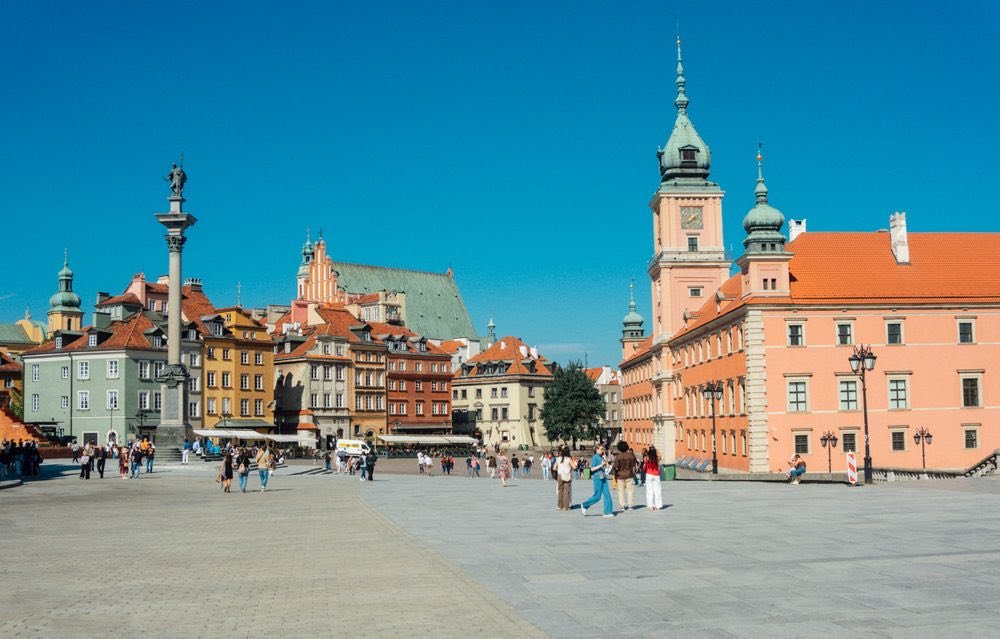
Warsaw rewards a short stay more than its reputation suggests. Almost the entire city was destroyed in the Second World War, and the Old Town you walk through today was rebuilt brick by brick from paintings and photographs. That story runs through the whole city, and two days is enough to understand it, eat well and see its green side. This plan avoids backtracking and works around museum closing days. For a broader overview, start with our Warsaw city guide.
At a glance: Two days cover the Old Town and Royal Route on day one, then POLIN, Łazienki Park and Praga on day two.
| Detail | What to know |
|---|---|
| Day 1 | Castle Square, Old Town, Royal Route, Nowy Świat, Palace of Culture |
| Day 2 | POLIN Museum, Łazienki Park, Praga |
| Entry fees | Royal Castle state rooms approximately PLN 35; POLIN approximately PLN 30; National Museum approximately PLN 20, free on Tuesdays, as of 2026 |
| From the airport | Chopin Airport to the centre by train and bus in 25-40 min |
| Closures | Royal Castle and POLIN generally closed Mondays; Warsaw Rising Museum closed Tuesdays; Wednesday to Sunday is the easiest window |
| Next stop | Kraków by train in about 2.5 h |
Before You Go
- Getting in: Chopin Airport connects to the centre by train and bus in 25 to 40 minutes. Our Warsaw airport transfer guide compares the options.
- Where to stay: The Old Town is picturesque but quiet at night; Srodmiescie (the city centre) has the most hotels and best metro access. See our best hotels in Warsaw guide or search Warsaw stays.
- Getting around: Day tickets cover metro, trams and buses. Our Warsaw getting around guide has the details.
- Closures: The Royal Castle and POLIN are generally closed on Mondays, and the Warsaw Rising Museum on Tuesdays. Wednesday to Sunday is the easiest window for this plan.
Day 1: Old Town and the Royal Route
Morning: Castle Square and the Old Town
Start at Castle Square (Plac Zamkowy), dominated by the Sigismund Column. The Royal Castle was blown up by German forces in 1944 and rebuilt in the 1970s and 80s. Entry to the state rooms costs approximately PLN 35 as of 2026, and the Canaletto Room, with its 18th-century views of Warsaw used to guide the post-war reconstruction, is the highlight. Check hours and book on the Royal Castle’s official site.
From the square, walk into the Old Town Market Square, ringed by colourful burgher houses. Follow the defensive walls north to the Barbican, a Gothic gatehouse. Wander the lanes for an hour without a plan; this is the best part of the Old Town.
A guided Warsaw Old Town walking tour is worth considering on the first morning, since the reconstruction story is easy to miss without context.
Midday: Lunch on the Royal Route
Walk south down Krakowskie Przedmiescie, the start of the Royal Route, past churches, the university and the Presidential Palace. For lunch, try pierogi, zurek or a modern Polish plate. Our Warsaw restaurants guide and Warsaw food guide have suggestions, or take a Warsaw food tour.
Afternoon: Nowy Swiat and the Palace of Culture
The Royal Route continues as Nowy Swiat, a pedestrian-friendly street of cafes and shops. Continue to the Palace of Culture and Science, Stalin’s “gift” to Warsaw, completed in 1955 and still the tallest building in Poland. Its viewing terrace offers the best panorama of the city for a small fee. Ironically, it is the one place from which you cannot see the palace itself, which is why locals say it has the best view in town.
Evening: Dinner and a Wander
Return to the Old Town after dark, when the square is lit and the day-trippers have left, or head to the Nowy Swiat and Foksal area for evening drinks. Our Warsaw nightlife guide covers the main areas.
Day 2: POLIN, Lazienki and Praga
Morning: POLIN Museum
Start at POLIN Museum of the History of Polish Jews, in the Muranow district. Eight galleries trace a thousand years of Jewish life in Poland, using reconstructions and testimonies. Entry is approximately PLN 30 as of 2026, and the museum is generally closed on Mondays. Allow at least 2.5 hours, and see the POLIN museum site for tickets.
Outside the museum stands the Monument to the Ghetto Heroes. Nearby, our Jewish heritage trail guide and Warsaw WWII tours provide more context. If your interest is the 1944 uprising rather than the ghetto, swap POLIN for the Warsaw Rising Museum; see our Rising Museum guide for what to expect.
Afternoon: Lazienki Park
Take a tram or taxi to Lazienki Park, 76 hectares of gardens, lakes and woodland. Visit the Palace on the Isle, the neoclassical summer residence of King Stanislaw August, and walk the park’s peacock-filled paths. From May to September, free Chopin piano concerts take place on Sunday afternoons near the composer’s monument. Arrive 30 minutes early for a seat.
For a bigger palace day, Wilanow is a 15 km bus ride south and fits better into a third day. Our Warsaw day trips guide lists options.
Evening: Praga
Cross the Vistula to Praga, the east-bank district that survived the war and has become Warsaw’s creative quarter. Street art, converted factory spaces such as Koneser, and a growing bar scene make it the best place for a last dinner. Trams and the metro connect it to the centre in around 15 minutes.
Eating Your Way Through Two Days
Warsaw’s food scene is broader than most visitors expect. Milk bars (bary mleczne) serve cheap soup, pierogi and cutlets, a full meal for roughly PLN 25-40 as of 2026. In the evening, the city has a strong modern Polish scene that reworks old dishes such as tartare, herring and zurek. Breakfast is easy on Nowy Swiat, where cafes open early. Save room for a paczek (filled doughnut), especially on Fat Thursday before Lent, when queues form outside bakeries across the city. A guided Warsaw food tour is an efficient way to cover several of these in one afternoon.
Understanding Warsaw’s Story
What sets Warsaw apart from Krakow is that its landmarks are reconstructions. After the 1944 uprising, German forces systematically demolished most of the city. Roughly 85 percent of the historic centre was destroyed, and the postwar rebuild of the Old Town earned it UNESCO World Heritage status in 1980 as an exceptional example of reconstruction. Keep this in mind on day one. The Canaletto paintings in the Royal Castle, the brickwork of the Barbican and even the lanes of the Market Square were rebuilt using surviving drawings, photographs and student surveys of the buildings. On day two, POLIN and the ghetto sites add the other half of the story. Reading our Warsaw Rising Museum guide before you arrive helps the museum visits land better.
Rain Plans and Seasons
Warsaw’s best sights have strong indoor alternatives. In rain, swap Lazienki Park for the National Museum, which holds Poland’s largest art collection (entry approximately PLN 20 as of 2026, free on Tuesdays). Winter brings Christmas markets on Castle Square and an early dusk, so do outdoor sights before 3:30 pm. In summer, the Vistula riverbanks fill with open-air bars on both banks, and a sunset drink there is a good alternative to the Praga evening. Spring and autumn offer the best weather and thinnest crowds.
Short on cash? Several stops on this plan are free, and our guide to 7 free things to do in Warsaw lists the free-entry days for POLIN and the Warsaw Rising Museum.
Practical Tips
- Tickets: Book the Royal Castle and POLIN online in summer.
- Cost: See the Warsaw cost guide for a full breakdown.
- Things to do: Our Warsaw things to do guide lists everything else, and the best tours in Warsaw roundup compares guided options.
- Next stop: Continue to Krakow by train in about 2.5 hours; our Warsaw to Krakow guide covers tickets, and our 2 days in Krakow plan picks up there. For a longer trip, see the 1-week Poland itinerary.